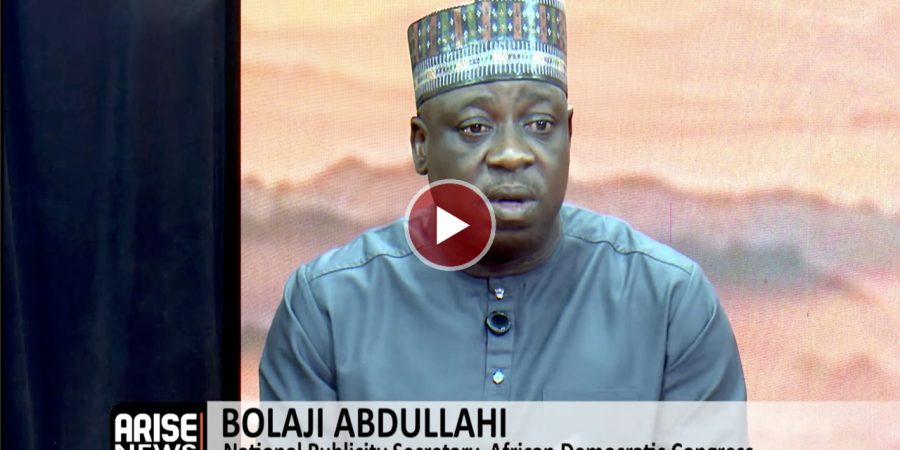
The national publicity secretary, African Democratic Congress, (ADC) and former Minister of Youth Development, and Minister of Sports, Bolaji Abdullahi, has said the party has stabilised following the defection of key political figures Peter Obi and Rabiu Musa Kwankwaso, insisting that the ADC remains committed to building a strong opposition coalition focused on reversing Nigeria’s worsening governance crisis.
“On the issue of people leaving our party, especially the big wigs as you called them—His Excellency Peter Obi and Senator Rabiu Musa Kwankwaso—yes, of course, I mean, it came to us a little bit as a surprise, but I think we’ve moved on from that. It was a glitch, and not the fine kind of glitch, I must say. But we’ve moved on from that; we’ve stabilized, and we’re moving forward because the objective is the same: how do we stop the steady deterioration of governance in our country and how do we strengthen multi-party democracy in our country?”
Speaking during an interview with ARISE NEWS on Wednesday, he added that despite the defections, the ADC still believes a broad opposition coalition remains achievable, stressing that only a united front can effectively challenge the ruling APC and overcome the advantages of incumbency ahead of the next elections.
“The vision of building a big coalition of opposition political parties is still a possibility within the dynamics that we are presented with because we are convinced that a unified opposition stands a better chance of challenging for power, especially when faced with the kind of incumbency that we are faced with,” he stated.
Abdullahi acknowledged that the collapse of efforts to unite major opposition figures under one platform was a setback for the broader opposition coalition, though he maintained it was not enough to derail ongoing efforts to build a formidable alliance against the ruling APC.
“It is not a setback for the ADC in particular, but a setback for the opposition coalition—the kind of coalition we’re trying to build, not specifically the ADC. Because once you have a three or four-horse race against the incumbent, it’s always an advantage to the incumbent. But like I said, it may have been a setback, but it’s not a fatal blow to the work that we are trying to do because the objective, like I said, remains the same and we are not wavering on that,” he maintained.
He added that the opposition still hopes to produce a single presidential candidate capable of challenging the incumbent administration, noting that discussions among political stakeholders remain open despite recent political realignments and defections.
“Ultimately, our hope and our expectation is that we will all still be able to find a way to work together. When we left Ibadan a couple of weeks ago, we said we’re going to present a common presidential candidate—a single presidential candidate against the ruling party. Conversation is still possible in that direction because the objective—if we are all committed to the same thing, if we all believe genuinely that this is why we’re doing what we’re doing, which is to stem the steady deterioration of the quality of life that we are seeing and the misgovernance of the ruling party—then it’s still possible for us to reach across and have that conversation,” Abdullahi stressed.
Speaking on the zoning debate within the opposition, Abdullahi said the ADC would approach the issue from a strategic standpoint, insisting the party’s priority is building a strong platform capable of effectively challenging the ruling APC in 2027.
“On the issue of zoning, for us in the African Democratic Congress, it’s not about whether it’s the principled thing to do. But we find ourselves in a peculiar situation where an opposition party and the decision we are going to take is going to be strategic rather than trying to be politically correct at this time. We are going to assess the field and look at our options and look at what gives us strategic advantage and strategic opportunity to really challenge for power. So we are not commenting on the principle of it, but we’re looking at it from the strategic point of view: what should we be doing if you have two or three aspirants or contestants from one part?”
Commenting on the views expressed by former Vice President Atiku Abubakar on zoning, Abdullahi reiterated that they do not reflect the official position of the ADC, adding that the party is yet to take a formal decision as it continues internal consultations on its broader strategic direction.
“It is not the ADC position, and that’s why I said I’m not going to comment on the principle of it. It is not ADC position; that is the position of Alhaji Atiku Abubakar. ADC has not taken a position on that because, like I said, it’s a strategic decision that we are going to make,” he reiterated.
Addressing Peter Obi’s defection from the ADC, the national publicity secretary for the ADC said only Peter Obi could explain his reasons for leaving the ADC, stressing that the party could not speak for him or defend his decision.
“I think it’s only Peter Obi that can explain why he left the ADC. I cannot speak for him, and I cannot defend his action or inaction,” he said.
Adding, he said that contrary to claims of internal crisis, there was no record of formal grievances or complaints raised before the departures of Obi and Rabiu Kwankwaso.
“I know for a fact that there had not been any conversation around any grievances. What happened when Mr. Peter Obi and Senator Kwankwaso left was more or less them throwing us a curveball because there had not been any conversation around any grievances,” he insisted.
On the idea of “homeland security,” Abdullahi maintained that the concept is ideologically loaded and does not properly align with Nigeria’s internal security realities.
“The concept of ‘homeland,’ like we said, is ideologically loaded. And when you begin to probe deeper, it begins to have other interpretations and connotations that don’t exactly fit into the Nigerian condition.”
He pointed out that the position of the ADC in the matter is that any security arrangement must be clearly defined and functionally necessary, warning against structures that could complicate coordination within Nigeria’s existing security framework.
“We felt it’s more of a deflection; the appointment is more of a political calculation rather than a strategic security decision. And that’s why we said so. Because what we hear them say is that the Special Advisor on Homeland Security will take care of insurgency, focus on insurgency, banditry, kidnapping. Then what is the National Security Advisor doing? Nigeria is not being invaded by foreign forces. All the issues of insecurity we’ve had are all internal. So if anything at all, if you still have the National Security Advisor in place, you have this Special Advisor in place, you have the Chief of Defence Staff, you have all these people, you are likely to add more to the chaos rather than making your coordination easier in a desperate situation like this. So that is the position of the ADC,” he warned.
On whether zoning is a matter of political necessity or contingency, Abdullahi said the ADC would prioritise winning elections and would adopt any lawful and strategic approach required to achieve that objective.
“We want to win. And we will take the best decision that puts us in a position to win. The purpose of a political party is to win elections. And as long as we are not violating any known law in Nigeria, we’re not violating any constitutional provision, we will do what is necessary within the law to win the election,” he stressed.
Sharing the ADC’s stance for security policy, Abdullahi outlined a four-point framework focused on strengthening local intelligence, improving state-level response capacity, enhancing national law enforcement, and deepening regional cooperation to tackle cross-border insecurity.
“Talking specifically about what ADC will do, we say we have a framework for this:
“Strengthening Local Intelligence Gathering; State-Level Deterrence; National-Level Enforcement; Regional Cooperation.
“So ADC is saying that we need to bring them back on board, because the more we are able to cooperate at a regional level, the better chance we stand of ensuring that these cross-border crimes are mitigated. So this is the framework that we have,” he shared.
Favour Odima
Follow us on: