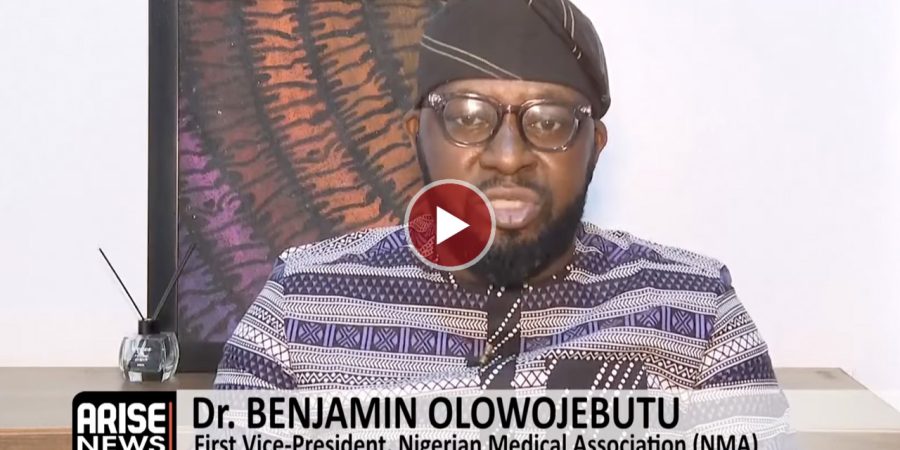
The first Vice President of the Nigerian Medical Association, Dr. Benjamin Olowojebutu has raised concerns over the increasing emigration of Nigerian doctors, citing poor remuneration and insecurity as key drivers of the trend.
Speaking in an interview with ARISE NEWS on Tuesday, Dr. Olowojebutu noted that worsening working conditions, including an overstretched doctor-to-patient ratio and exposure to workplace violence, are pushing many medical professionals to seek opportunities abroad.
This follows data from the General Medical Council showing that at least 4,690 Nigerian doctors have left the country for better working conditions abroad, especially in the United Kingdom.
“One of the major factors that is pushing everybody away is inadequate remuneration. Doctors don’t feel very blessed working in Nigeria. They don’t get paid properly. Doctors feel that they are not being given the value they give to the economy and give to the state.
“Number two is security. Some doctors leave their homes to go and do calls at night; they get maimed, they die, and nobody remembers them. Every time we celebrate Nigerian Armed Forces Day, nobody celebrates Nigerian Healthcare Day where doctors are maimed and die in the line of work. Some doctors are beaten and assaulted by patients’ relatives when there’s an issue in the hospital. These are the things that push people away from working in this country,” he revealed.
Dr. Olowojebutu also said urgent reforms are needed in Nigeria’s healthcare system, particularly around remuneration and working conditions for doctors. He stressed the need for a properly reviewed Collective Bargaining Agreement to reflect current economic realities, alongside improved allowances, tax relief, and broader incentives to retain medical professionals in the country.
“There’s a policy of employer-employee relationship with the government. Every three years, there must be a sit-down of a CBA (Collective Bargaining Agreement) to negotiate new salaries as relevant to the economic realities of the nation. But the last time we had this done in Nigeria was 14 years ago. We are glad that now there’s an ongoing CBA that started in August 2025 by the government. Let them quickly finish the CBA, increase the salary of doctors, and give them more allowances,” he advised.
Acknowledging recent improvements in medical remuneration, while also noting that the current administration has begun addressing long-standing salary inconsistencies, The NMA First Vice President commended the correction of outstanding allowances under the 2011 agreement, describing it as a positive step by government.
“In the last 14 years, there has been a major distortion in the agreement we had with the government regarding our salaries and remunerations. However, this government has corrected that inconsistency. Our professional allowances have now been properly improved to reflect the 2011 agreement. That 14-year-old agreement is just being paid this year; the government has corrected that part, and we salute them for it,” he said.
However, he stressed the need for sustained reforms through regular salary reviews, improved welfare packages, tax relief, better insurance, and stronger incentives to retain healthcare workers in the country.
“What we are saying now is that the consistency of salaries should be based on an agreement every three years. Let the government make that consistent. When our teachers finished medical school back in the day, they finished with a car, a house, and a family—meaning they had convenience and were celebrated by the government. Right now, that is not happening. Even insurance is not available for medical doctors in that same way. So, these are the things we pray for from this government: Give adequate remuneration attention to doctors. Provide tax rebates and tax relief,” he highlighted.
Noting that some doctors in the country struggle with basic living expenses, Dr. Olowojebutu highlighted that Nigerian doctors currently earn between ₦250,000 and ₦500,000 monthly, which he said is insufficient compared to the cost of living, including rent and transportation.
“To give you figures, you have a doctor earning between ₦250,000 and ₦500,000, whereas their house rent for a year is about ₦2 million. Most doctors cannot afford to buy a proper car anymore; they jump from Danfo to BRT. There are no transportation allowances for them.”
He added that the ongoing Collective Bargaining Agreement talks offer a chance to introduce new allowances, including rural and scarce-skill incentives.
“But let me give you a reassurance going forward: the government has given us an opportunity to do a Collective Bargaining Agreement (CBA). We have put together a proposal for newer allowances to encourage doctors and to reduce what we call ‘internal Japa’ Some doctors working in rural communities or local governments want to move to the city because they believe the funds and remuneration are better there. What happens to our families in those rural communities?”, he quizzed.
He further stressed the need for stronger accountability in Nigeria’s primary healthcare system, questioning the quality and staffing of many facilities across local governments.
“One of the problems in this country is proper accountability; we often like to do what we call a ‘facade.’ We have 774 local governments in Nigeria, but how many of those Primary Health Centers (PHCs) are manned by a medical doctor?”
He advised that Primary Health Centres should be physician-led, with properly trained doctors in charge, supported by adequate incentives such as rural and scarce-skill allowances to improve service delivery.
“The focus of the NMA is to have a physician-led Primary Healthcare Center. Doctors should lead the facility to provide value for the people, but you must adequately compensate them with rural and scarce-skill allowances. They need to feel loved and engaged. It’s not just about building facilities; it’s about equipping those facilities with doctors who can lead the change we want,” he said.
Favour Odima
Follow us on: