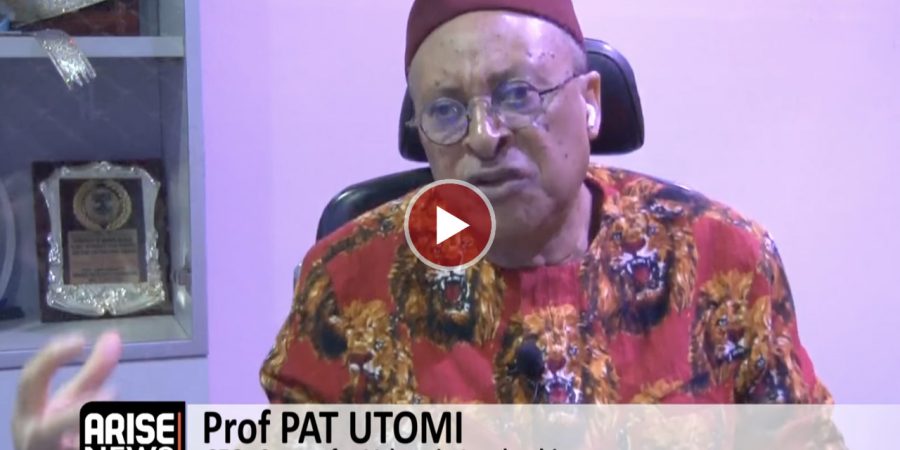
Political economist, academic and former presidential candidate, Professor Pat Utomi, has said Nigeria’s deepest political and moral failures can be traced to the country’s transition from military rule in 1999, warning that the abandonment of ideas for raw power has poisoned public life and hollowed out democracy.
Utomi in an interview with ARISE News on Wednesday in an interview marking his 70th birthday, reflecting on Nigeria’s past, present and future, and on the personal cost of a lifetime spent insisting that ideas, values and integrity must matter in politics.
Asked what life had taught him about Nigeria that he wished he had understood earlier, Utomi said the country’s struggle should be viewed through a long historical lens.
“A few days ago, Reverend Father George Ehusani reminded me of Socrates,” he said. “He tried to console me that I should not feel bad if what I preached most of my life has not yet shaped Nigeria. Socrates was encouraged to drink poison, but Western civilisation was built on his thoughts. So, in some ways, I am supposed to be consoled by the fact that after I am gone, Nigeria may become great because of the ideas I expressed.”
Utomi said he still hoped to see progress within his lifetime, insisting Nigeria has a unique historical mission.
“I believe Nigeria was gifted to humanity to redeem the trampled dignity of the Black man and to reverse the road to serfdom paved by colonial oppression and slavery,” he said. “If we focus on being a redeeming generation, we could walk away feeling we helped make Nigeria the trigger for that redemption.”
On whether Nigeria listens more to ideas or to power, Utomi said the country had turned its back on intellectual leadership.
“At a point in our history, people turned away from valuing ideas,” he said. “If you read Obafemi Awolowo in his 30s and 40s, he was a profound philosopher. If you listen to Fela Anikulapo Kuti, he was one of the great philosophers of all time.”
According to him, the decisive rupture came with military rule and oil wealth.
“What I call the dangerous alchemy of soldiers and oil changed everything,” Utomi said. “The military is centralising by nature, while Nigeria’s founders chose a decentralised federal structure. Then oil revenues began to flow, and we created a prebendal culture — a rent economy where people focused on how much they could extract from the system.”
He said this shift degraded public life.
“Less deserving people moved into public office. Culture was poisoned by ‘me, myself and I’. Consuming narcissism pushed thought aside. People began to say, ‘my grandma go chop’, and they missed how societies actually develop,” he said.
Utomi warned that power without ideas leads to lasting harm.
“Power is not everything,” he said. “You can get power and use it to do so much evil, and in the end you will be remembered as the person who destroyed possibilities.”
Reflecting on the personal cost of speaking truth to power, Utomi said the price was heavy and constant.
“Oh, plenty, plenty, plenty,” he said. “This culture despises truth-tellers. Somebody suddenly becomes deputy governor of the Central Bank through a nepotistic system and decides that anyone associated with someone who speaks truth should be frozen out.”
He said this repeatedly undermined his economic security.
“All your efforts to build basic material security can be ruined, and for me it happened regularly,” Utomi said. “So I had to devise a survival strategy. I didn’t want my children to suffer because I chose the path of rectitude.”
Utomi said he worked several times harder than his peers and spread his professional life across continents.
“I had jobs on three continents. If Nigeria froze me out, I still earned enough to pay my children’s school fees and give them an upper-middle-class upbringing,” he said. “Yes, there were lots of costs.”
Describing Nigeria’s democracy as “procedural but hollow,” Utomi said the country has rotated elites rather than transformed governance.
“Nigeria has been painfully disappointing because people in public office allowed self-love to exceed care for the people,” he said. “Public life should be about the pursuit of immortality — sacrificing for the common good.”
He said political culture had deteriorated further with the normalisation of hate.
“The most terrible thing the political class has done is make hate part of our culture,” Utomi said. “Dividing people by ethnicity or religion for power does lasting damage. Economic growth cannot take place in such an environment.”
Despite this, he said he remained hopeful.
“The possibilities for a great Nigeria still exist,” he said. “Leadership can emerge that thinks inclusively and focuses on the greater good, not the little things people grab and leave behind when they die.”
On the growing emigration of talented Nigerians, Utomi said what appears as brain drain could become brain gain.
“I once wrote an essay titled The Generation That Left Town,” he said. “Those who got the best education in Nigeria never really governed the country. But what we call brain drain may become brain gain.”
He added: “If you look at Japan, China and India, the diaspora played a key role. I believe Nigeria’s renaissance will come from its diaspora.”
Asked how younger Nigerians view his generation, Utomi said the response was mixed but encouraging.
“All this celebration of my turning 70 was organised by my mentees,” he said. “Young businesspeople funded everything. I see many young people who value what we tried to do.”
He cited examples such as Paradigm Initiative founder Gbenga Sesan and entrepreneurs involved in Enugu’s emerging innovation hubs.
“These are young people doing remarkable things, and I’ve had the privilege of walking with them,” Utomi said.
If he could rewrite one chapter of Nigeria’s post-military history, Utomi said his intervention point was clear.
“Clearly, 1999,” he said. “When the military was leaving, many credible people did not trust that the military was truly going away. They stayed out, and undesirables moved into politics. We’ve been paying the price since.”
He lamented the loss of a political culture where rivals could disagree without hatred.
“Politicians used to campaign during the day and play tennis together in the evening,” he said. “That ended in 1999.”
On whether Nigeria can still be fixed by ideas, Utomi insisted ideas remain decisive.
“I never thought of myself as a man of ideas; I thought I was practical,” he said. “But ideas rule the world. There is nothing concrete that did not start from a theory.”
Drawing inspiration from Singapore’s transformation, Utomi said Nigeria’s mission remains achievable.
“In one generation, Singapore went from third world to first,” he said. “I believe Nigeria’s possibilities remain. Nigeria will be a great country.”
Boluwatife Enome
Follow us on: