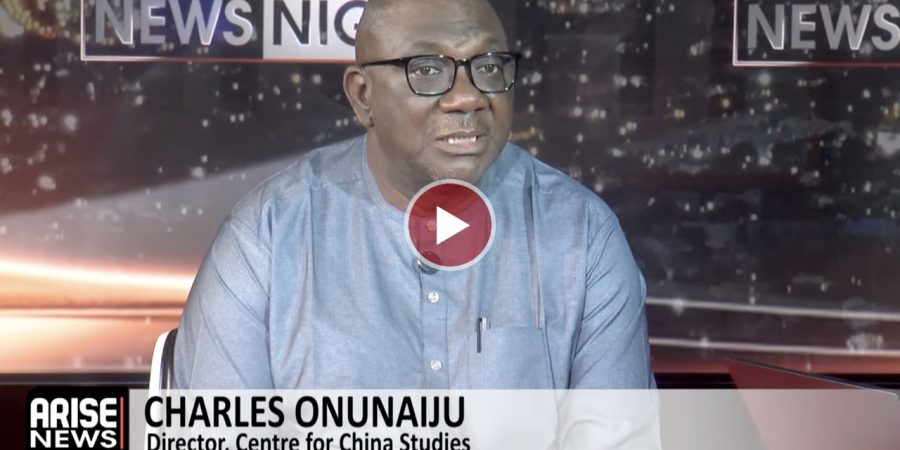
Director of the Centre for China Studies, Charles Onunaiju, says Nigeria must seize China’s zero-tariff access for African exports as a “low-hanging fruit” capable of transforming its economy and addressing insecurity.
Speaking in an interview with ARISE News on Wednesday during discussions marking 55 years of diplomatic relations between Nigeria and China, Onunaiju described the bilateral relationship as a “work in progress” but one that has recorded significant achievements, particularly through sustained institutional cooperation.
The Institute for Peace and Conflict Resolution is hosting an anniversary dialogue to assess the impact of the partnership on development, peace and regional stability, as well as explore new areas of cooperation amid shifting global dynamics. China remains Nigeria’s largest bilateral creditor and a major financier of infrastructure projects in transport, energy and industrial development.
Reflecting on the trajectory of ties between both countries, Onunaiju said:
“Well, I would say it’s a work in progress, but quite a lot has been achieved, especially with the two countries having sustainable cooperation, establishing what I say is one of the unique bilateral processes, the intergovernmental dialogue, which promotes discussion across the board. And this has been sustainable over time. Of course, to speak into a whole range of engagements across the board, infrastructure, like your report indicated, we’ve seen quite a lot of them.”
However, he stressed that the greater opportunity lies ahead, particularly in China’s decision to grant non-tariff treatment to African exports.
“But I would like to speak more importantly about the prospects beyond 55 years. For me, that is an important low-hanging fruit. Just recently, the Chinese promised or indicated to give non-tariff treatment to all products coming from Africa, including manufactured, agricultural, and all that.
For me, this is very significant. This is a market of 1.4 billion people. And if we can secure even 1 per cent of this market, that would be considerably game-changing, especially for what we have been speaking about for years — diversification of the economy.”
He explained that China’s ongoing economic transition presents fresh openings for Nigeria.
“China is implementing its 15th Five-Year Development Plan. And one of the core aspects of this is to develop and consolidate a unified national market, which means China will be having the largest single market of anyone in the world.
China is making a very, very impressive transition from what it used to be — the workshop of the world — now to the market of the world.”
Onunaiju noted that trade between both countries currently stands at about $22 billion, with a deficit of nearly $16 billion in China’s favour. He argued that preferential access to the Chinese market offers Nigeria a pathway to rebalance trade.
“Of the $22 billion trade, we have a deficit of almost $16 billion in favour of China. And they have provided us concessional access to the market, including non-tariff, which means everything we export to China has no charge. And this is very important for us.
Our agricultural products — sesame seeds, groundnuts, cashew nuts, soya beans, coffee — they all have tariff-free access.
You can imagine the implication for that, even for security. I can assure you, if bandits in the forest know they could become millionaires through ginger farming, they could become millionaires through cashew nut farming, they could become millionaires through sesame seed farming, they will drop the gun.”
Addressing concerns about the trade imbalance and the limited presence of Chinese manufacturing in Nigeria, Onunaiju argued that investment decisions are driven by business realities rather than sentiment.
“I will tell you something: the Chinese businesses and enterprises are not missionaries who thrive in crisis zones. They are also looking for money; they are also making money. They are in business.
So they will go to where you have whole production factors — steady power supply, prospects of industrial harmony, of course security, and of course a unified tax regime — where you don’t have local government coming up with a tax, state government coming up with a tax, and then sometimes a whole range of understandings are not implemented.”
He added that some Chinese firms had previously exited Nigeria due to economic and policy instability.
“The Chinese companies are willing to come here. A number of them came here and left on account of the pressure on the environment, sometimes unstable domestic currency. It has a whole lot of pressure on them. So they move.”
Warning that Nigeria risks losing out to neighbouring countries under the African Continental Free Trade Area (AfCFTA), Onunaiju cited examples of Chinese firms relocating to smaller markets while targeting Nigeria’s larger consumer base.
“His Royal Highness was very nimble in his point regarding this issue — that very soon we will have Chinese companies relocating to Benin, relocating to Ghana, but focusing on the Nigeria market.
How many are in Ghana? Twenty-five million. Benin, less than that. So they will set up a factory there, give them the jobs, give them the added value, and then sell to us.
And now we are into the African Continental Free Trade Area, which will make it seamless for these goods to move from one African country to the other. It doesn’t matter what label it bears; as far as it comes from Ghana, it is going to have tariff-free entry into Nigeria.”
He urged Nigerian policymakers to respond strategically.
“So we have to step up. What are the policy responses to this opportunity? That’s the point.
China is a global opportunity. You could see just in less than a month, it’s literally been a pilgrimage of sorts — all European leaders.
So what we are saying is, let’s get it right. Let’s identify specific, targeted policy instruments that clarify the opportunity of China, especially not only for Chinese businesses, but also for Nigerian businesses.”
Nigeria and China formally established diplomatic relations in 1971 and have since expanded cooperation across infrastructure, trade and strategic engagement, anchored on mutual respect and the One-China policy.
Boluwatife Enome
Follow us on: