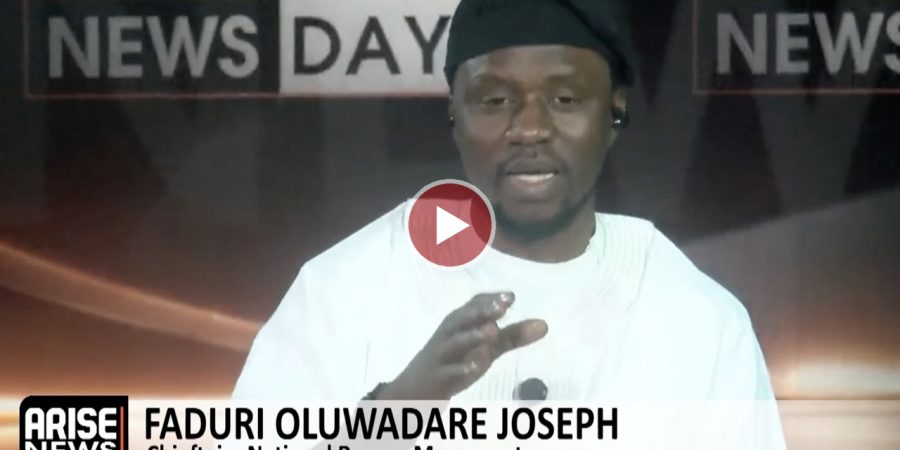
Nigeria’s decades-long struggle with insecurity, economic hardship and institutional decay can be traced directly to corruption and reckless mismanagement of public funds, according to Faduri Oluwadara Joseph, popularly known as Father Joe. The National Rescue Movement (NRM) presidential hopeful insists that without accountability and strict financial discipline in governance, no policy reform or political transition will deliver meaningful change. For him, corruption is not just a symptom of Nigeria’s crisis it is the foundation of it.
Speaking in an interview with ARISE News on Friday, Joseph identified self-serving leadership as the central defect in Nigeria’s political system. He argued that leaders have repeatedly prioritised personal gain over national development, creating a governance culture built on impunity.
“The problem we have in this country is we have leaders who put themselves first instead of the nation first.”
According to him, this leadership failure has institutionalised corruption to the extent that accountability mechanisms have virtually collapsed across public institutions.
“Corruption is so deep into the public society. We are running a country where there is no law and order. Where there is no reward and accountability. No reward and punishment.”
Joseph cited what he described as staggering financial discrepancies as evidence of systemic rot, pointing to allegations of massive missing public funds without consequences for those involved.
“There was a report that over the years, over 200 trillion is missing in the NADC. Up to now, nobody has been questioned. No consequences.”
He questioned how a country could make progress under such circumstances, arguing that the absence of consequences encourages further looting and fiscal recklessness.
“So in a nation where over 200 trillion is missing, and nothing is happening, how can such a nation move forward?”
Beyond alleged missing funds, he criticised what he considers misplaced budgetary priorities, particularly large public expenditures that, in his view, do not directly benefit ordinary Nigerians.
“A nation where we have a president going for medical treatment. 34 million budget for the office of the president for medical treatment. You can imagine what that money will do if we use that money to create hospitals in our country.”
He argued that such financial decisions reflect deeper governance problems, where public office is disconnected from public need.
Joseph further suggested that similar fiscal decisions in security and international engagements demonstrate a pattern of mismanagement.
“You can imagine if we put that money into our military, what we would have done.”
For Joseph, these examples are not isolated cases but indicators of a broken accountability system that has allowed corruption to flourish unchecked.
“So corruption and mismanagement of public funds is why we are where we are today.”
He maintained that reversing Nigeria’s decline requires restoring law, order, and strict financial accountability at every level of government.
“When we get into power, it’s going to be people’s first and nation’s first.”
Joseph framed the 2027 election as an opportunity for Nigerians to reject what he described as decades of financial abuse and demand transparent governance.
“Getting involved in this next election is the best that can happen to every one of us.”
By centering his campaign message on corruption and fiscal accountability, Joseph positions the fight against financial mismanagement as the starting point for national renewal. In his view, insecurity, unemployment, poor healthcare, and weak institutions are downstream effects of unchecked corruption. Whether voters will rally behind his call for systemic reform remains uncertain, but his message is unmistakable: without ending corruption, Nigeria cannot move forward.
Triumph Ojo
Follow us on: