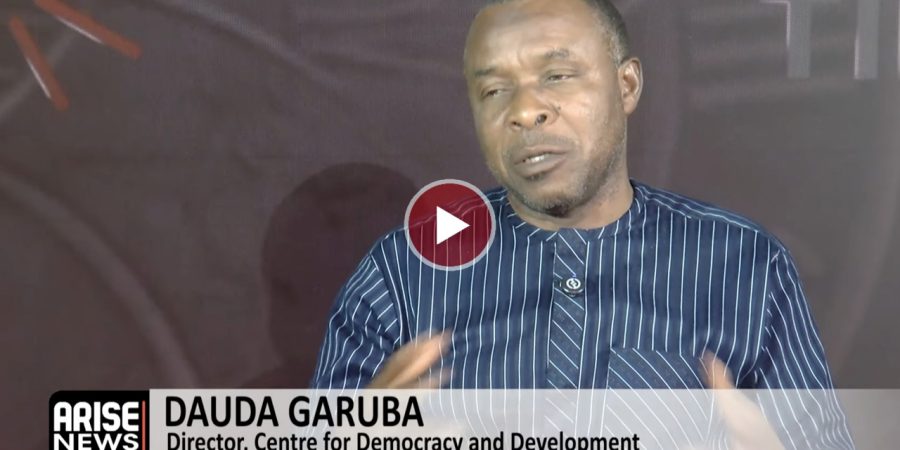
Director of the Centre for Democracy and Development (CDD), Daouda Garuba, has said the recent Federal Capital Territory (FCT) Area Council elections highlighted persistent challenges in Nigeria’s electoral process, including low voter turnout and vote-buying, even as the process remained largely peaceful.
Speaking in an interview with Arise News on Monday, Garuba described the elections as a critical “dress rehearsal” for the 2027 general elections.
“Well, obviously, having been in this for a long time now, you may want to measure this from different angles. The first angle, if you take the kind of atmosphere that characterised the election itself, it was relatively peaceful. I’m not saying there were no hitches here and there, but the fact remains that there was relative peace in virtually where you go,” Garuba said.
He noted, however, that voter participation was extremely low, citing firsthand observations at polling stations. “I got to a particular police unit where of the 1,168 people that were supposed to vote, as at the time I got there, only two persons had voted so far. So, this is the extent to which turnout was low. Of course, in some places, people simply had other priorities early in the morning, but by late morning, they started coming to cast their votes.”
Garuba praised the Independent National Electoral Commission (INEC) for conducting the elections without manipulative interference. “We didn’t, in any serious situation, see INEC personnel being manipulative of the process. Personally, I did not see anywhere where they acted otherwise,” he said.
He acknowledged minor administrative and logistical hitches but found no evidence of large-scale irregularities that could alter results. “In the statement we issued, we actually identified a few hitches, which largely were administrative, and also largely logistical,” Garuba explained.
On the role of technology, Garuba cautioned that electronic transmission of results is just one component of transparency.
“Beyond just the transmission, we should also be interested in the process that generated the figures that we are transmitting. Relying solely on that transmission will not give any good analysis of the situation. It’s a complete package,” he said.
Addressing reports of vote-buying, Garuba observed that the practice was widespread, reflecting broader systemic challenges. “One of the very criminal acts that I saw in the field was vote buying. You couldn’t run away from it, and it’s also not limited to the FCT elections.
“Usually, the very simple way people interpret it is that there is always a government in power suspected to have the upper hand in terms of buying. But there is also a way I looked at it, and that’s where the issue of getting people to come out for elections is essential.
“If all of us are out, you can stress them financially to the point that they won’t be able to pay any longer. So sitting back at home, not coming out to exercise your franchise, because you feel your votes don’t count, is also on us as citizens,” he said.
Garuba analysed voter behaviour and the broader political context, noting that disillusionment from the 2023 elections and growing poverty influenced participation.
“A lot of things have happened since 2023. People at some point felt disillusioned that what we needed was a system that would allow this level of transmission of results and not take on the manual bit. All these factors, including increasing poverty and inequality, combined to make people decide what to do,” he said.
Despite low turnout, Garuba argued that the results reflected genuine voter preferences within the context of those who voted.
“At the end of the day, you go to count the votes that were cast, and in that context, and given the environment where there wasn’t violence that would stop voting, it was clear people were voting. Votes were counted,” he said.
Looking ahead to 2027, Garuba highlighted risks that Nigeria must address, including rebuilding citizens’ confidence in the electoral system.
“The first thing is the confidence of the people that has largely eroded as a result of what happened in 2023, which they are gradually seeing happening in some of the subnational elections.
“We need to reconnect with the people to reactivate their interest in voting. If we are able to do that, we can build on it with respect to other scenarios,” he said.
Garuba cautioned that while incremental reforms have been made, substantial work remains to safeguard electoral integrity. “Nothing has happened significantly that demonstrates we are moving forward on all the issues citizens wanted addressed. The issue of electronic transmission has crowded out other equally important concerns,” he said.
He urged civil society and citizens to respond proactively to challenges rather than resigning to disillusionment.
“He who fights and runs away lives to fight another day. We might be in a position to take the country further forward. We’ve had some reforms in the electoral act, and we need to consider the best responses to challenges as members of civil society,” he said.
Boluwatife Enome
Follow us on: