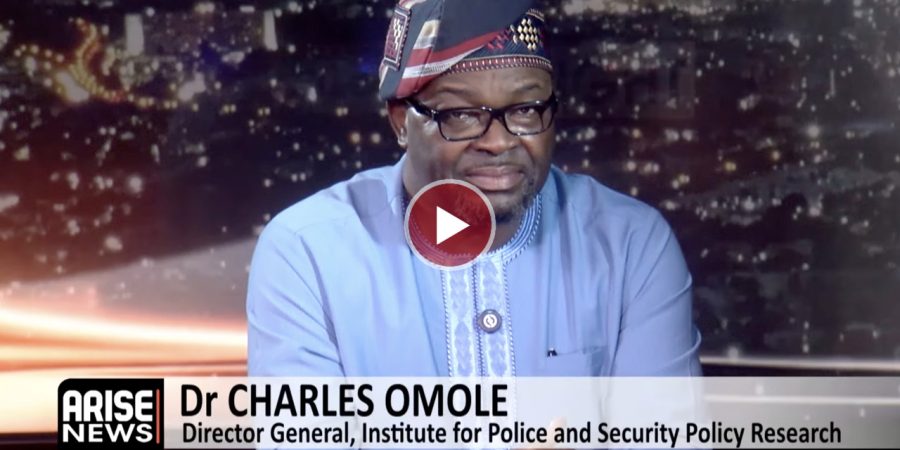
The Director-general, Institute for Police and Security Policy Research, Dr. Charles Omole has stated that state policing can work in Nigeria, if strict safeguards are put in place.
Dr. Omole said this in an interview with ARISE NEWS on Friday where he shared a rich history of state policing in Nigeria.
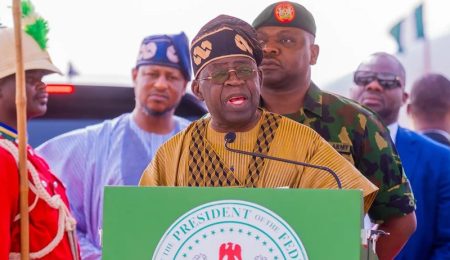
This comes after President Tinubu’s recent appeal to the Senate to prioritise constitutional amendments for the establishment of state police across the nation.
“For state police to work now, there are certain guardrails that need to be put in place”, he stated.
He further confirmed that state police is not a new concept in Nigeria, but one that dates back to the colonial times.
“I mean, the colonial masters actually started what we call the ‘local native police.’ Up until 1960, we had what we call the Nigeria Police Force, which is like the federal police”, he noted.
He also explained that certain governors are not welcoming of the idea of state police because of the cost involved.
“So the issue now about why some governors are for it, why some governors are against it, is partly cost. Let me explain. As at 1966, we had the three tiers of policing. Then we also had regional prisons and federal prisons. So when the decision was made to centralize the police, the decision was also made to centralize prisons. So by 1970, we now had one Federal Prison Service.
“So if we are going back to state police, states must now establish their own prisons. And it will come at a cost. So states will now have to build their own prisons. That’s cost to it, not just of infrastructure, but also cost of feeding prisoners. Right now, states don’t pay anything for that because everything is absorbed by the Federal Prison Service. So it’s not just a cost of employing police officers. And that is a genuine fear”, he explained.
He additionally cited various strategies that could be adopted to make state policing a reality.
“State police can happen, but certain guardrails have to be put in place. The Federal Character Principle that exists nationally will have to exist on the state level. Otherwise, you will have a segment of the state dominating the state police, for example. And then we have the same problem over and over again.
“This can be crafted in the laws that are put in place. So my suggestion really is: the President, the way he handled valiantly the issue of the tax reform, I think it’s the same way he should handle this issue of state police, which is; set up an expert panel. And the reason why the tax one worked was because the head of that panel is not a politician. Same thing for the state police: a federal presidential panel on implementation of state policing. There has to be uniformity in ranking across the states. You don’t want a sergeant in State A to be equivalent to an inspector in State B elsewhere. There has to be the kind of equipment, weapons they can hold at the state level. In terms of training, what kind of training can you give them? What’s the protocol of relationship between the state police and the federal police?”, he advised.
Highlighting more measures that should be established for the implementation of state policing, Dr. Omole said:
“So part of what needs to be put in place is that there has to be criteria each state must meet before they have their own police. Like what? For example, even something as basic as: how do you store your crime data? There has to be interoperability between State A and State B. We don’t want to have 36 different policing systems in Nigeria and then A can’t talk to B.
“So a lot of technical details need to be worked out. It can happen. I understand the President’s sentiment that we need state police, and to be quite frank with you, given what I know, I think it’s the only direction to go”, he stressed.
He however noted that establishing state policing is a complex process requiring constitutional and legal changes,
“There will have to be a change. No, even the legal framework is more complicated than people think. Change in Constitution, then there are laws that we need to be repealed, there are new laws that we need to be written. I don’t see it happening in the next two to two and a half years”, he said.
Favour Odima
Follow us on: