
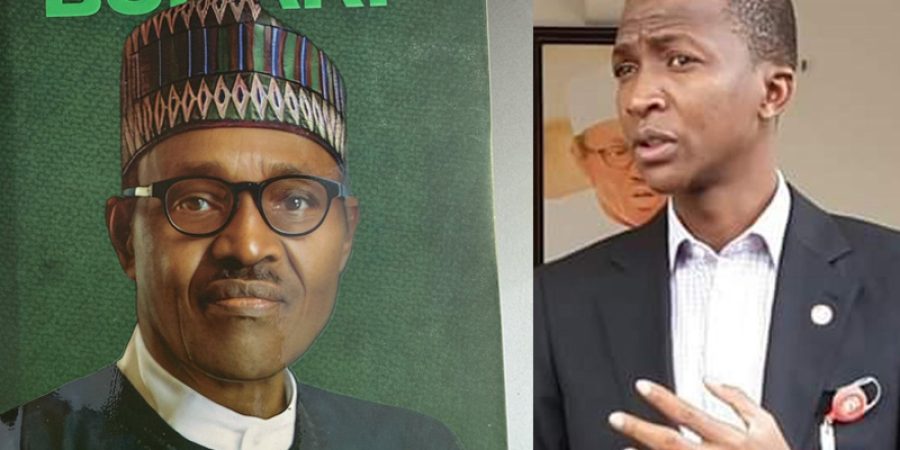
A biography of immediate past President, Muhammadu Buhari launched on Monday has revealed that the controversial naira redesign policy implemented under the Buhari government was conceptualised by the then Chairman of the Economic and Financial Crimes Commission (EFCC), Abdulrasheed Bawa.
The book, From Soldier to Statesman: The Legacy of Muhammadu Buhari, officially unveiled at the Conference Centre of the State House, Abuja, disclosed that the proposal to redesign the naira did not, as widely believed, originate from the Central Bank of Nigeria (CBN) under its former governor, Godwin Emefiele.
Rather, the biography authored by Dr Charles Omole, however, offers a more detailed narrative, stating that the idea was conceived within the leadership of the Economic and Financial Crimes Commission (EFCC), with the explicit objective of starving vote buyers of cash ahead of the 2023 general poll.
According to the account, the policy, launched in October 2022, preceded a severe cash crunch that plunged millions of Nigerians into hardship, triggering what many described as a humanitarian crisis in the months leading up to the polls.
While officially called as a reform to promote a cashless economy, strengthen monetary policy and curb illicit activities such as ransom payments, cash hoarding and vote buying, its implementation proved deeply disruptive.
Few policies of the Buhari government generated as much heat. With hindsight, critics viewed the redesign as a political move aimed at undermining the governing party’s electoral prospects.
Buhari had before the redesign approved a proposal from monetary authorities to upgrade domestic currency production, ending reliance on foreign printers and building national capacity.
He funded the necessary upgrades and insisted on local capability. It was along this trajectory, the book noted, that the redesign proposal emerged, now packaged with the ambition of sanitising cash flows and undercutting money politics.
Buhari’s long-standing aversion to money-driven politics aligned with the pitch. By the time it became apparent, at least to some within the security establishment, that the political and operational costs were spiralling, the process had gathered irreversible momentum. Currency samples had been printed and timelines fixed.
As the biography suggested, not every policy can be elegantly withdrawn once the machinery is in motion.
The biography explicitly named then EFCC chairman, Abdulrasheed Bawa, as the originator of the redesign proposal.
Director-General of the Department of State Services (DSS), Yusuf Magaji Bichi, is quoted in the book as saying the EFCC boss proposed the policy “with the explicit goal of starving voter-buyers.”
According to Bichi: “Buhari’s instinct aligned. “He had fought money politics for decades and was attracted to an idea that might, even painfully, clean up the field. Buhari was sure Asiwaju would win, so he was not concerned about cleaning up the process and levelling the field.”
Amid insinuations that the policy was designed to damage the ruling party, Bichi said Buhari ordered that investigative reports be sent directly to him, wary of sabotage or misrepresentation.
Yet the President’s posture remained consistent: avoid interference in law enforcement, insist on transparency, and allow events to unfold without weaponising the state against opponents or shielding allies.
Beyond policy, the book also offered a rare, intimate portrait of Buhari in the eyes of his former Chief Security Officer (CSO), Abubakar Idris whose account is less about partisan battles than about the discipline, restraint and institutional habits of a Commander-in-Chief.
He described a President who delegated freely, demanded results without micromanagement, and shunned gossip.
‘We encounter the human Buhari too: a leader who refused the public arrest of a relative, insisted on stopping at red lights even in convoy, and believed that dignity itself was a form of national security.
Idris explained that delegation defined Buhari’s presidency. “Trust was the red line. Once the President trusted you, he gave you space to perform, but that space came with responsibility.”
Excuses, he adds, had only fleeting validity.
Access to the President was tightly regulated. Appointments mattered. Gatekeeping was professional, even when it unsettled the powerful. Idris recalled stopping a newly appointed Chief of Staff at the Villa gate for lacking an appointment, and stood his ground.
According to the biography, Buhari never overruled such decisions, even when influential figures bristled.
In a political culture where proximity often masquerades as privilege, that consistency, Idris argued, reinforced institutional dignity.
The book also challenged persistent rumours of a shadowy cabal isolating Buhari from reality. Idris insists the President was well informed through structured systems, not whispers.
Daily executive summaries, covering national security, power generation, fuel supply and political developments, according to the book, were delivered seven days a week.
Buhari was said to have read them, asked questions and issued directives where necessary.
“He knew,” Idris concluded offering a counternarrative to one of the most enduring myths of the Buhari years.
In her account, former First Lady, Aisha Buhari, has disclosed that her hubby, Buhari, suffered from long history of malnutrition which affected his health when he was the president.
According to the biography, Aisha also stated that some powerful individuals who were working with the president polluted his mind against her to the extent that the former president started locking the door to his rooms to prevent her from having access to it.
The book quoted the former president’s wife of saying that her husband’s health crisis in 2017 did not originate as a mysterious ailment or a covert plot.
“It started, she said, with the loss of a routine; ‘my nutrition,’ she describes it, a pattern of meals and supplements she had long overseen in Kaduna before they moved into Aso Villa in 2015.”
According to her account in the book: “When the presidency’s machinery took over their private lives, I sat with his close personal staff (the physician, th CSO, the housekeeper) and even the Director-General of th SSS in a final meeting”.
She explained the plan: “Daily, at specific hours, cups and bowls with tailored vitamin powders and oils, a touch of protein here, a change to cereals there. Elderly bodies require gentle, consistent support.”
‘We are sitting for the first and the last,’ she remembers saying. ‘He doesn’t have a chronic illness. At this age, you care for them like a child; immune systems are not the same. Add this, remove that. Keep him on schedule. She explained to them her husband’s long battle with malnutrition symptoms and how she has been using supplements to balance his dietary intake for many years.
“Then, in her account, came the gossip and the fear mongering. These same personal staff began planting ideas and suspicions into her husband’s mind. ‘They said I wanted to kill him.’ She sounds more wounded than angry when she recalls it, but the decisions that followed were not neutral.
“Perhaps these were not ordinary actions, she wondered. “My husband believed them, for a week or so,” she said. ‘He started locking his room, changed small habits.’ And the kitchen, the heart of the routine, went off script. Meals were delayed or missed; the supplements (used for years, she says) were stopped.”
It was stated that Buhari, who was a slender man and rarely ate much, even in better times, began to lose weight.
“For a year, he did not have lunch.
He maintains a routine. They mismanaged his meals.’ Aisha claimed her husband had a long history of malnutrition, and for over six years before he entered the villa, she carefully managed his diet; vitamins here, nutrient supplements there. As a result, a routine was well established and effective. These measures kept him strong and healthy.
“However, she said she was told Buhari was now “State Property” and not just her personal husband; consequently, her regime was overruled, and his Villa personal team (and their backers) went on a frolic of their own.”
Aisha Buhari said her husband was not poisoned as alleged in some quarters and that there was no exotic fever lurking in air vents but his problem was that his nutrition was compromised and badly managed.
She said when Buhari was rushed to London, the doctors prescribed an even stronger regimen of supplements than what she had been giving him.
According to the book, Mrs Buhari recounted that during the final days of Buhari when he had left office and being in his eighties, his body bearing the marks of an old life; months in the bush during the civil war; soaked uniforms dried by the heat of the day, nights without air conditioning and the life of austerity he had lived, had taken a toll on his lungs.
“After leaving office, in his final year before passing, phone calls increased and transatlantic trips became more frequent. The family’s calendar was filled with funerals and flights.
“He had gone to the UK, she says, as he often did to repair a tooth and enjoy the summer air. She stayed behind in Abuja, mourning a nephew; then returned to London, then went back to Nigeria when an uncle died. “
Follow us on: