
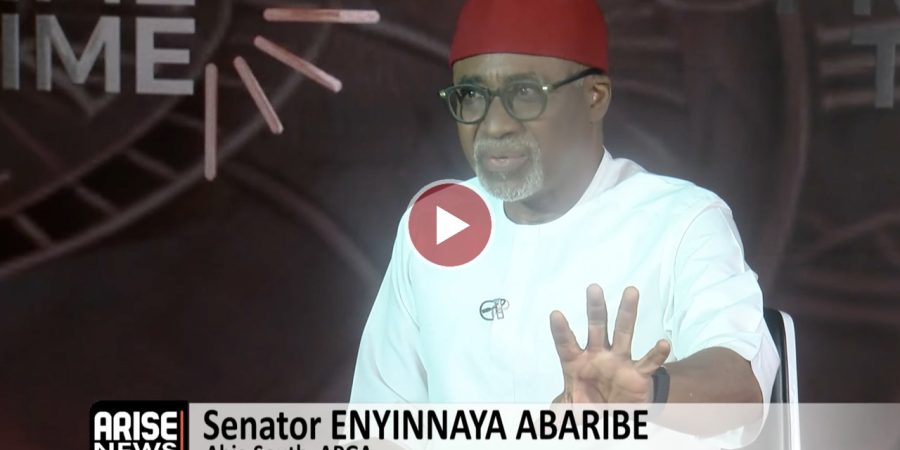
Representive of Abia South Senatorial District on the platform of the All Progressives Grand Alliance (APGA),Senator Enyinnaya Abaribe,
has insisted that the Senate approved real-time electronic transmission of election results, dismissing reports suggesting otherwise as a misunderstanding rooted in legislative procedure and wording.
Speaking in an interview with ARISE News on Thursday, Abaribe said the controversy surrounding the Senate’s decision was unnecessary, stressing that what lawmakers approved was “transmission, not transfer” of results — a distinction he described as deliberate, legally significant, and essential to credible elections.
“Yes, the Senate approved it, and I will tell you how it happened,” Abaribe said. “What we passed is transmit, not transfer. What existed in the 2022 Act was transfer, and we don’t want a law that is vague.”
He explained that the confusion arose from Nigeria’s past electoral disputes, particularly after the 2023 elections, when courts consistently ruled that INEC guidelines were not law.
“In the last elections, which were conducted under the 2022 Act, all the way to the Supreme Court, the courts held that INEC guidelines were not law. That was why everyone agreed that the law itself needed to be clear, concise, and leave no room for ambiguity,” he said.
According to the senator, the amendment process was exhaustive, involving broad consultations over an extended period.
“From 2024 to now, the Senate Committee on the Electoral Act and the House Committee met 27 times. They met with INEC, civil society organisations, and all stakeholders. What was agreed and brought back to us was electronic transmission of results through the IReV,” Abaribe said.
He added that when the report was presented, the Senate constituted an ad hoc committee to further review the amendment before proceeding into an executive session to finalise contentious issues.
“We went into executive session so we could speak frankly among ourselves. We approved everything we could approve, including electronic transmission. When we returned to plenary, it was simply to formally adopt what had already been agreed,” he explained.
Abaribe said senators were therefore surprised when reports emerged, even while they were still in the chamber, that electronic transmission had been rejected.
“While we were still in the chamber, we started getting reports that this wasn’t what was passed. Everybody was perplexed. I personally went to the Senate President, and he clarified that what we passed was transmission, not transfer,” he said.
Concerned about public confusion, Abaribe said some senators immediately moved to set the record straight.
“We didn’t want any confusion. Nigerians don’t want courts deciding elections again. That is why we said the process is not complete until the votes and proceedings are adopted,” he stated.
He explained that the votes and proceedings stage allows senators to correct any discrepancy between what was agreed and what is documented.
“When the votes and proceedings are brought, if what we see is transfer instead of transmission, we will say, ‘No, Mr President, that is not what we approved,’” he said.
On concerns that the Senate’s integrity was at stake, Abaribe acknowledged the gravity of the situation.
“Every senator’s integrity is at stake because we are there only on public trust. Nigerians sent us there to do this job for them,” he said.
He further clarified why the Senate deliberately removed any wording that gives INEC discretion over the process.
“The reason is simple. Anytime you go to court, once the law says ‘according to INEC guidelines,’ the courts will say guidelines are not law. That is why we removed it,” Abaribe said.
“The language we approved compels INEC to transmit results in real time. There is no discretion given to INEC.”
Defending the principle behind real-time transmission, the senator said transparent elections benefit everyone, including politicians.
“If you claim you came on the mandate of the people, why would you want something murky? I came here on the mandate of the people of Abia South. I would prefer that on election day, through real-time transmission, they tell me they don’t want me anymore,” he said.
Responding to scepticism that lawmakers fear real-time transmission because it limits post-election manipulation, Abaribe said clarity in the law was the only way to reassure Nigerians.
“The only way to convince a sceptical public is to ensure that the wording of the law is clear, concise, and open to everyone — even non-lawyers. We don’t want any room for interpretation,” he said.
He warned that if the final harmonised bill weakens electronic transmission, lawmakers would resist it.
“Not just me — a majority of senators will oppose it. We debated this fully in executive session,” he said.
Abaribe also defended the decision to deliberate in closed session, saying it was to avoid grandstanding and distractions.
“When cameras are on, people play to the gallery. We didn’t want that. We wanted to tidy things up properly, and we did,” he said.
Expressing confidence in the direction of reform, Abaribe said Nigeria would not reverse progress made since 2023.
“The Senate President himself said Nigerians should know we are not going backwards; we are moving forward,” he said.
“In 2023, my own results were already on IReV before collation ended. We knew where we stood. That is the system we are continuing.”
In closing, the senator urged Nigerians to actively engage their elected representatives to protect electoral reforms.
“Talk to your senators and members of the House of Representatives. They represent you. If what you want is a clear and concise law on electronic transmission, call them and tell them. I received many calls today, and I told them not to worry — this is where we are,” Abaribe said.
He added that Nigerians should closely watch the adoption of the votes and proceedings, which he described as the final safeguard ensuring that real-time electronic transmission remains enshrined in law.
Boluwatife Enome
Follow us on: