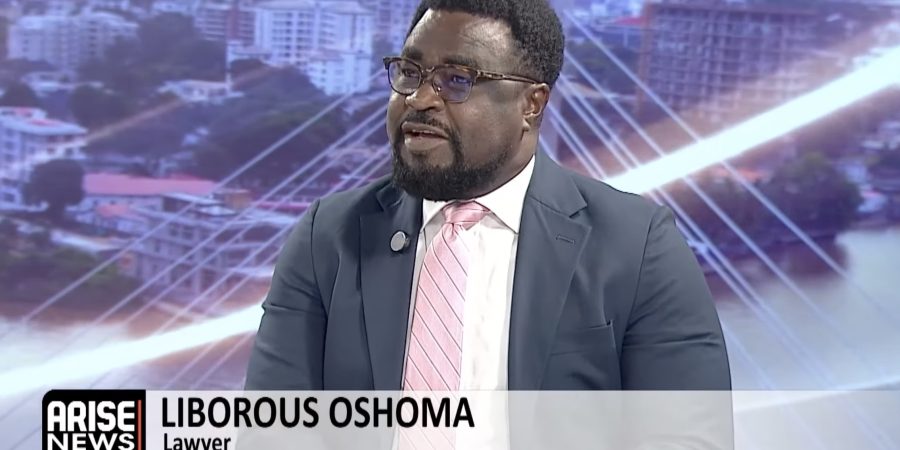
Lawyer , Liborous Oshoma, has faulted the Federal High Court ruling directing the Independent National Electoral Commission (INEC) to deregister the African Democratic Congress (ADC) and four other political parties, insisting that the electoral body cannot be compelled to remove parties it has already confirmed met constitutional requirements.
Speaking in an interview with ARISE NEWS on Tuesday regarding controversy surrounding the judgment, Oshoma argued that INEC, which is constitutionally empowered to determine compliance with political party registration requirements, had already stated before the court that the affected parties satisfied the threshold for continued registration.
“INEC is saying, no, these political parties have crossed this threshold. And so, you can’t compel us to deregister them.”
Oshoma explained that the controversy centres on Section 225A of the Constitution. “Lots of people still don’t understand the provisions of section 225 paragraph A. It’s an amendment to the constitution, actually, And what did this section say? It simply says, the INEC shall have power to deregister a political party for breach of any of the requirements for registration.”
“Failure to win at least 25% of votes cast in one state of the federation in a presidential election, one local government of the state in a governorship election, or failure to win at least one ward in chairmanship election, one seat in the national assembly election, or one seat in the councillorship election. Just one of these conditions.”
He noted that contrary to the basis of the suit, the ADC had already satisfied the constitutional requirements through its performance in the 2023 general election. “The ADC, for example, we all know, won the House of Reps seat in the 2023 election. So, that alone has fulfilled the requirements of section 225A. That alone.”
Oshoma argued that INEC had already carried out its constitutional responsibility after the elections and had even deregistered parties that failed to meet the prescribed thresholds. “And believe it or not, even after the election, INEC deregistered, in compliance with this section, INEC deregistered some political parties, because that act is ordinarily supposed to be carried out after election and now INEC has started another process. They have registered some other political parties. They have also conducted due diligence on some other parties, because they had started another election cycle.”
Oshoma maintained that the timing of the suit and the court’s decision was inappropriate.
In his words. “This not the time to activate this section because laws are not applied in vacuum and then this is not the time to activate this section because laws are not applied in vacuum. They are applied taking cognisance of the realities on ground.”
He also questioned the legal standing of the National Forum of Former Legislators, which instituted the suit, arguing that the group failed to demonstrate any injury or direct interest that would justify bringing the action before the court.
According to him, public interest litigants are expected to show the injustice they stand to suffer if an action is not taken. “The first question the court will ask you is, what injustice have you, as a person, or will you suffer if this action is not done?”
Oshoma further described the suit as lacking merit and questioned the basis upon which the plaintiffs sought to compel INEC to act against its own position. “These people are mere busybodies. This is a frivolous.”
He aslo drew attention to an earlier order of the Court of Appeal granting a stay of proceedings in the matter, arguing that the Federal High Court ought to have exercised restraint pending the determination of issues before the appellate court. “One would have expected that the court would restrain itself in going ahead to give an order.”
According to Oshoma, it is a well-established judicial practice for lower courts to avoid proceeding with matters already before a superior court to prevent conflicting decisions.
“Beyond the legal questions, the ruling could deepen public suspicion about political interference in the affairs of opposition parties.”
He said the circumstances surrounding the case were likely to fuel perceptions that unseen political interests were at work. “You’re hearing the voice of unknown persons, but the hand of the APC, certainly the community would be high.”
Oshoma noted that several politicians, including serving lawmakers and a sitting governor, had recently joined some of the affected parties, making any attempt to retroactively activate deregistration provisions problematic. “Senators have decamped into this party. House of Rep members have decamped into this party. One of the parties has a sitting governor decamping into it.”
He questioned why the court proceeded with the judgment despite affidavits filed by INEC stating that the affected parties had complied with constitutional requirements. “All of these issues that you have raised, it comes to an affidavit, a counter affidavit, and stated all of these issues. And so, and then yet the court still went ahead to give its judgement.”
Expressing concern about the wider implications for the judiciary, Oshoma warned that controversial rulings could erode public confidence in democratic institutions. “This is not good, not just for our democracy, but for the judiciary, because today the world is a global village.”
Erizia Rubyjeana
Follow us on: