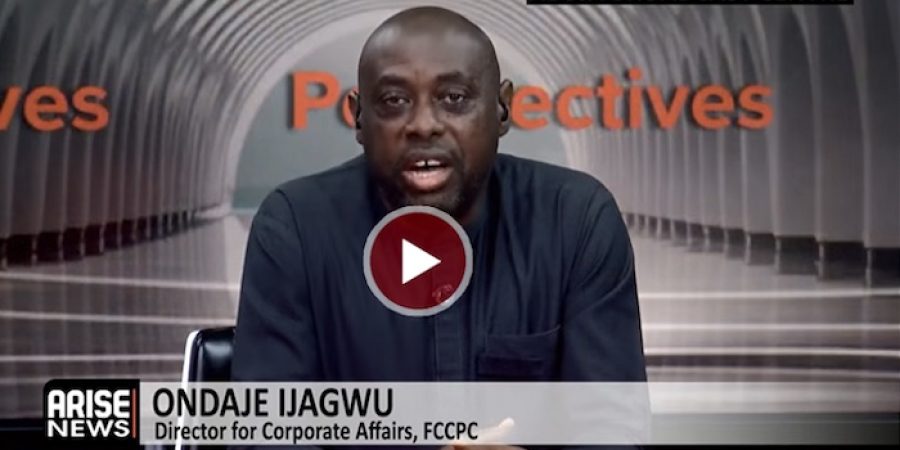
The Director of Corporate Affairs at the Federal Competition and Consumer Protection Commission (FCCPC), Ondaje Ijagwu, has condemned the growing trend of consumers being arrested over product complaints, insisting that dissatisfaction with goods and services should remain a civil matter, not a criminal offence.
Speaking in an interview with ARISE NEWS on Saturday, Ijagwu said consumers must be free to express their views without fear of intimidation or arrest.
“Whatever a consumer says, rightly or wrongly, should not result in criminal prosecution,” he said. “Consumer rights is not something that is localised. All over the globe, when you buy goods or pay for services, you have the right to express views and critique quality.”
Ijagwu criticised what he described as increasing misuse of police powers by businesses to silence critics, citing multiple recent cases.
“This is a purely civil matter. If you are alleging product defamation, that is a civil matter. If you are alleging product defamation, that can never be a crime,” he said.
He referenced ongoing and past disputes involving consumer complaints, including cases involving Risco and Bone Straight products, where complainants were reportedly detained.
“We had to go to Zone 2 late at night to secure a release in one of the cases. This is another example where the police are getting involved in a matter that is purely civil,” he added.
Ijagwu also condemned the arrest of individuals linked to complainants during investigations.
“Two individuals were apprehended in the course of searching for her. Arrest by proxy is not allowed,” he said, referring to a recent case involving a woman who criticised a children’s textbook.
He described the incident as part of a wider pattern of intimidation.
“Business owners seem to have made up their minds that nobody can hold them accountable,” he said. “There is no law in Nigeria that criminalises product complaints or product criticism.”
The FCCPC spokesperson stressed that the agency exists to resolve disputes between consumers and businesses, often through non-public mediation.
“As an organisation, we do not handle consumer complaints publicly. We do them quietly in our offices,” he said. “We do not see consumer complaints as a declaration of war.”
He, however, admitted the agency may need to increase public awareness of its work.
“Given the concern Nigerians are expressing, we will begin to publicise those resolutions more,” he said.
Ijagwu revealed that the commission has handled thousands of complaints in recent months.
“In six months of 2025, we resolved 9,071 complaints and recovered over 10 billion naira for consumers,” he said.
Ijagwu urged the Inspector General of Police to issue clear directives to curb the arrest of consumers over disputes with businesses.
“I want the Inspector General of Police to come out and say this madness has to end,” he said. “Police in Nigeria have become an agency for all purposes, but they should not be used to intimidate consumers.”
He emphasised that Nigerian law protects free expression, including consumer feedback.
“Consumers have the mandate under the Nigerian Constitution to express themselves,” he said. “You cannot come to the FCCPC with falsehood or malicious intent, but you can certainly come with facts and experiences.”
Ijagwu concluded by urging both businesses and consumers to embrace dialogue rather than confrontation.
“A complaint is not an enemy of progress. It is often the beginning of it,” he said.
Boluwatife Enome
Follow us on: