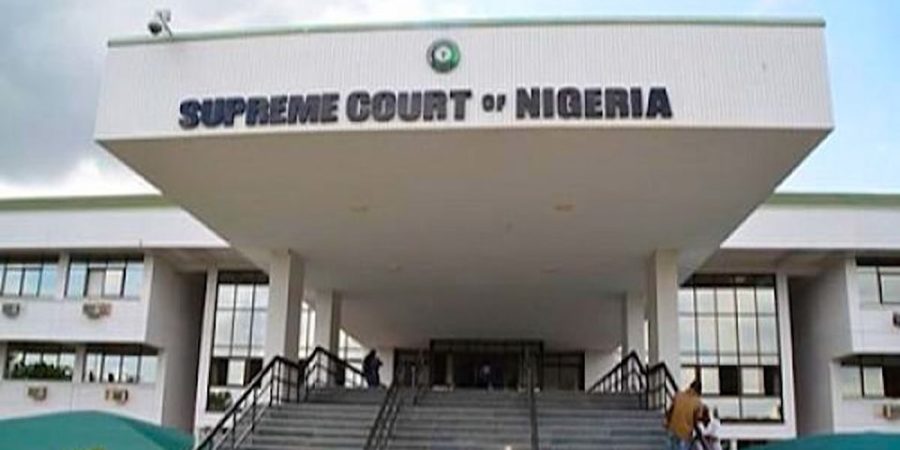
After nearly 10 days of anxiety and worries, the Supreme Court will today, April 30, deliver a “make or mar” verdict in the appeal surrounding the leadership tussles in both African Democratic Congress (ADC) and Peoples Democratic Party (PDP).
The judgement will be delivered exactly nine days after the five-member panel of justices of the apex court reserved their verdict in the appeals surrounding the authentic leadership of the two opposition parties.
That was as the Abuja division of the Federal High Court again issued an order restraining Independent National Electoral Commission (INEC) from recognising or participating in states congresses of ADC not conducted by their executives.
The order came barely six months after the same court barred INEC from participating or recognising the outcome of the national convention of PDP, which held on November 15 and 16, 2025, in Ibadan.
However, today’s verdict of the apex court would either draw the curtain on the hopes of ADC and the Tanimu Turaki-led PDP of participating in the 2027 general election or provide fresh vigour for ADC, the main opposition coalition, and PDP to try to wrest power from President Bola Tinubu and his All Progressives Congress (APC), come 2027.
The five-member panel led by Justice Mohammed Garba had last Wednesday announced that judgement had been reserved to a date to be communicated to parties. That was shortly after lawyers representing ADC and PDP in the different appeals adopted their processes as their briefs of argument for and against the appeals,
THISDAY, on Wednesday, learnt that the apex court was set to deliver its verdict on the ADC and PDP appeals today.
In the event the appeal succeeds it would clear the coast for the David Mark-led leadership to participate and field candidates in all elective offices in the 2027 general election.
But if the appeal fails, ADC would be shut out of the polls on the grounds that it did not have a leadership that would conduct and supervise the selection of its candidates in the general election, ditto for the Turaki-led PDP.
For ADC, the appeal set for judgement is between the Mark leadership and former Deputy National Chairman of the party, Nafiu Bala Gombe.
At the last proceedings, Jibrin Okutepa, SAN, who represented Mark, urged the apex court to allow the appeal, on the grounds that the apex court had in a judgement delivered on March 21, 2025, put an end to the issue before the court, when it held that, “no court has jurisdiction to entertain cases bordering on internal affairs of political parties.”
Okutepa urged the apex court to allow the appeal and hold that the trial court lacked jurisdiction to entertain a suit bordering on ADC’s internal matters.
However, Robert Emukpero, SAN, who represented the first respondent, Gombe, urged the apex court to reject the appeal and affirm the judgement of the lower court, which held that the case of the appellant was premature and dismissed it.
After taking arguments from all parties, Justice Mohammed Garba, who presided over the proceedings, announced that judgement was reserved to a date that would be communicated to parties.
Yet, the appellate court had in a ruling in the appeal filed by the Mark-led leadership against the ruling of the Federal High Court, Abuja, ordered status quo ante bellum.
Based on the ruling of the appellate court, INEC withdrew the recognition accorded the Mark-led executive as the authentic leadership of ADC.
Gombe had last year dragged the Mark-led executive before Justice Emeka Nwite to challenge the leadership of the party.
He had among others sought an order restraining the Mark-led leadership from parading itself as leaders of ADC, and claimed that he remained the authentic leader of the party, following the resignation of the then chairman and other members of the executive.
Mark, it would be recalled, was announced the chairman of an interim national executive of ADC at a meeting in Abuja, last year, with his chairmanship substantiated at the convention of the party held recently in Abuja.
However, Nwite declined to issue a restraining order against the Mark-led leadership but rather ordered the applicant to put the defendants on notice.
Reacting, Mark approached the appellate court to challenge the jurisdiction of Nwite to entertain the suit by Gombe, in the first place.
While insisting that the trial court could not entertain the suit by Gombe, for being an internal matter of ADC, Mark also argued that the trial court became functus officio, when the judge refused the grant of the restraining order against the Mark-led leadership.
But, the appellate court, in its judgement last month, dismissed Mark’s appeal and returned the case to the trial court.
While the appellate court had ordered accelerated hearing in the matter, it went ahead to order status quo ante bellum, an order which INEC acted upon to de-recognise the Mark leadership as well as remove their names from its portal.
Displeased, Mark approached the Supreme Court to set aside the ruling of the appellate court.
Only a few days ago, ADC pleaded with the Supreme Court to deliver its judgement in the appeal within the next three days.
ADC, in a letter to Chief Justice of Nigeria (CJN), Justice Kudirat Kekere-Ekun, stated that failure of the apex court to deliver judgement within the period would jeopardise the chances of the party in the 2027 general election, as well as dash the hope of millions of Nigerians intending to vote for ADC and its candidates at the general election slated for early January next year.
In the letter dated April 28, the party’s lead counsel, Mr Shuaibu Aruwa, SAN, recalled that the apex court “graciously heard expeditiously on April 22, 2026 and judgement was thereafter reserved to a date to be communicated by the court”.
Aruwa stated, however, that they were “most respectfully constrained to request for the CJN’s kind intervention and directive in ensuring that the judgement was rendered timeously”, on the grounds that INEC, the fourth Respondent in the said appeal, purportedly, acting pursuant to the judgement of the lower court in Appeal No: CA/ABJ/145/2026, had removed or de-recognised the leadership of ADC.
The senior lawyer submitted that the action of INEC had left ADC without leadership at the moment even though ADC remained a recognised registered political party in Nigeria.
In addition, ADC drew the attention of the CJN to INEC’s timetable for the 2027 general elections and the activities in readiness, which it said had already commenced.
In PDP, the battle is between a faction said to be loyal to Minister of the Federal Capital Territory (FCT), Nyesom Wike, an ally of President Bola Tinubu, and the camp of Oyo State Governor, Seyi Makinde.
The legal battle stemmed from the conduct of the PDP national convention in Ibadan last year, which produced the Turaki-led national executive.
While Austin Nwachukwu and two other PDP chieftains had dragged the Ambassador Iliya Damagum-led national executive before Justice James Omotosho of the Federal High Court, Abuja, over alleged noncompliance with the party’s guidelines as well as the Electoral Act in the conduct of the PDP convention, former governor of Jigawa State, Sule Lamido, on the other hand, dragged the party before Justice Peter Lifu of the same Federal High Court, to challenge his exclusion from the convention.
At last Wednesday’s proceedings, when the appeal between the Turaki-led executive of PDP versus Lamido was called, Paul Erokoro, SAN, who represented the appellant urged the apex court to allow the appeal and set aside the judgement of the Court of Appeal, which nullified the Ibadan convention on the grounds that the convention was held in disobedience to the orders of the Federal High Court.
Lamido, through his lawyer, Ewere Aliemeke, urged the apex court to dismiss the appeal in its entirety for lack of merit.
The same plea was made by O. A. Adeyemi, who represented INEC and Chief Joseph Daudu, SAN, who represented the third to fifth respondents.
Daudu, urged the apex court to hold that the appeal did not fall within the spheres of internal matters of political parties.
In the other PDP matter against Nwachukwu and two others, Chief Chris Uche, SAN, who argued the appeal for PDP, submitted that the two lower courts granted orders against the party’s convention without jurisdiction.
He accordingly urged the apex court to set aside the two judgements and hold that the lower courts erred in assuming jurisdiction in the internal matters of PDP.
After taking arguments from all parties, Justice Mohammed Garba, who presided over the proceedings, subsequently announced that judgement was reserved to a date that would be communicated to parties.
Lifu of the Federal High Court in Abuja had last year, in a judgement, restrained the then Ambassador Iliya Damagum-led National Executive Committee from proceeding with the convention slated for November 15 and 16, 2025, in Ibadan Oyo State.
Lifu had in his judgment ordered that the convention should not hold until Lamido, an aspirant to the office of national chairman, was given the opportunity to purchase interest and nomination forms to enable him participate in the convention for the election of national officers.
The party, however, went ahead to conduct the convention in disregard to the orders of the court.
PDP had predicated its action on the grounds that the court of Lifu lacked jurisdiction to stop the convention as the issue brought before him was an internal matter of PDP, which no court had jurisdiction to delve into.
The appellate court, in its judgement last month, disagreed that the issue at the trial court was an internal affair of a political party, which courts could not entertain.
The three-member panel of the appellate court subsequently nullified the outcome of the convention for being held in disobedience to the orders of the Federal High Court, Abuja.
Dissatisfied, PDP approached the apex court praying it to accept the appeal against the lower court judgement, set the judgement aside, and hold that the issue was an internal matter of PDP, which both the Court of Appeal and Federal High Court lacked jurisdiction to entertain.
Like PDP, Court Again Restrains INEC from Recognising ADC’s State Congresses
The Abuja division of the Federal High Court, again, issued an order restraining INEC from recognising or participating in ADC state congresses not conducted by their executives.
This came barely six months after the Federal High Court barred INEC from participating or recognising the outcome of the national convention of PDP, which held on November 15 and 16, 2025, in Ibadan,
Justice Joyce Abdulmalik, who issued the restraining order on Wednesday, also ordered the national executive led by Mark not to interfere with the functions and tenure of elected state executives.
Abdulmalik made the orders while ruling in an originating summons filed by Norman Obinna and six others on behalf of the states’ chairpersons and executive committees of ADC.
They had approached the court to challenge the legality of actions taken by a caretaker or interim national leadership.
The plaintiffs claimed that the national caretaker committee lacked the constitutional authority to organise state congresses or appoint committees for that purpose.
Among the prayers made to the court were an order affirming their tenure and another stopping any parallel body from carrying out their functions.
Delivering ruling on Wednesday, Abdulmalik, who held that the plaintiffs’ case had merit, clarified that the issue before the court was whether the second to sixth defendants, including Mark, had constitutional or statutory authority to assume the powers of an elected state organ of ADC, whose tenure was constitutionally guaranteed.
The judge stated that Section 223 of the 1999 Constitution provided that political parties shall conduct periodic elections on a democratic basis, while Article 23 of the party’s constitution provided that national and state officers shall hold office for a maximum of two terms of eight years.
“The question is whether there is any infraction committed by Mr Mark and co-defendants when they convened meetings and appointed a body known as a congress committee to organise state congresses,” she said.
Responding to claims of “internal affairs of political parties not justiciable” by defendants, the judge held, “Where there is an allegation of breach of constitutional or statutory provisions, the court has a duty to intervene.
“Where a party alleges that its constitution has been violated, the court is bound to adjudicate. Any argument that this court lacks jurisdiction on that basis fails.”
The court urged political parties to comply strictly with their constitutions, adding that courts could intervene where there was a breach of constitutional or statutory provisions.
According to the court, the procedure adopted by the defendants, including the appointment of a “congress committee”, was not recognised by the party’s constitution.
Besides, the judge observed that the tenure of state executive committees remained valid and must be allowed to run its course, adding that only the elected structures has the authority to organise state congresses.
Abdulmalik subsequently set aside the appointment of the committee and restrained INEC from recognising any congress organised by it.
The court also restrained the Mark-led leadership from organising congresses or conventions outside the provisions of the party’s constitution.
The suit was instituted by way of originating summons by the plaintiffs, led by Obinna and six others. They sued on behalf of state chairmen and executive committees of ADC.
The defendants included ADC, Mark, Patricia Akwashiki, Malam Bolaji Abdullahi, Ogbeni Rauf Aregbesola, Oserheimen Osunbor, and INEC.
Chuks Okocha, Alex Enumah, Sunday Aborisade and Yinka Kolawole
Follow us on: