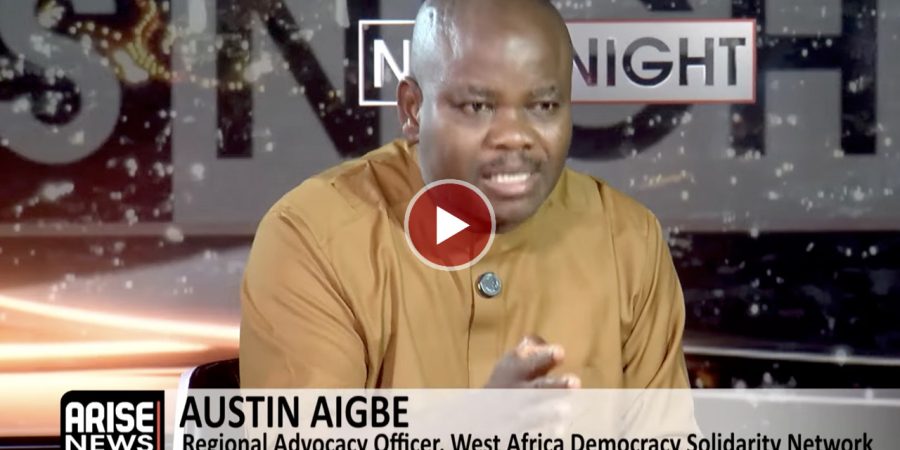
Regional Advocacy Officer for the West Africa Democracy Solidarity Network, Austin Aigbe says the suspension on voter registration by INEC is only public, as plans are still ongoing internally.
He said this while speaking with ARISE NEWS on Monday on voter revalidation and electoral integrity in Nigeria.
“I agree that it’s been suspended, but what is suspended is the publicity and formal plans. However, they are still maintaining internal planning, so we don’t know if it will come back on the table after the next meeting,” he said.
Highlighting the importance of addressing voter turnout in Nigeria, Aigbe noted that despite having over 93 million registered voters, actual participation often remains between 28% and 30%. He pointed out that this discrepancy results in significant waste, with millions of ballot papers printed but unused, incurring unnecessary costs.
“I agree with what the INEC Chairman said regarding the timing. In the Ghana 2024 election, we often talk about the high turnout—why can’t Nigeria achieve that? Nigeria runs between 28% and 30%, which is arguably low.
“We spend so much money preparing for 93 million registered voters, and the actual turnout is significantly lower. I’ve done a metaphorical analysis: if you print 100 million ballot papers and the turnout is only 30 million, that means 70 million are wasted. We spend money to print them and money to burn the unused ones, all while we are borrowing.
“There are ways to limit this waste. I think this is the time to talk about electronic voting—not internet voting, but electronic voting like Kaduna State used in 2018 for local government elections. You still go to the polling unit to cast your vote. We need revalidation to remove deceased individuals and those who have ‘Japa’d’. There should be a legislative framework where every decade we revisit the register,” he suggested.
Speaking further on voter registration, Aigbe noted that incomplete revalidation inflates the numbers of active voters.
“It’s a fact. There may only be 50 to 70 million true registrants because many haven’t revalidated. We have a law that requires a permanent register, so we need to tinker with that law. Can we conduct voter registration ahead of every election? There is a challenge with the Nigerian system, but the ultimate point is: you don’t implement this kind of policy 18 months before an election. It sends the wrong signal. You have four years between elections; why wait until now?”
Aigbe argued that rushing revalidation now sends the wrong signal, as trust remains the fundamental issue.
“I asked the INEC Chairman directly: ‘Can we trust you?’ He acknowledged that trust is a major issue. You don’t come up with these programs just because there is a budget allocation. INEC has a very tight timetable. Even the one-year notice period is barely enough. Revalidation is essentially like a new registration; people are already complaining they can’t register online or schedule physical capture.
“Instead of spending resources on revalidation now, why not clean up the existing register and plan for a proper registration cycle starting in 2028? We should link voter registration with electronic voting so they are synchronized. If India, with its level of illiteracy, can use devices to vote, why can’t we? People argue about a lack of internet in villages, but you have internet to make calls and send messages from those same villages. It’s common sense,” Aigbe said.
Explaining further, Aigbe said the cleaning process only catches double registrations and doesn’t remove deceased voters, which requires proof from the National Population Commission.
“The cleaning he mentioned only catches double registrations. It doesn’t remove deceased persons. To remove a deceased person, you need validation from the National Population Commission. We’ve even had politicians print fake obituary posters of opponents to try and get them removed from the register!
“To truly identify who is alive or dead, you need proof—hospital certifications and legal processes. It’s a rigorous system. The Chairman knows that just saying someone has died isn’t enough; you must show cause and proof,” he stated.
Favour Odima
Follow us on: