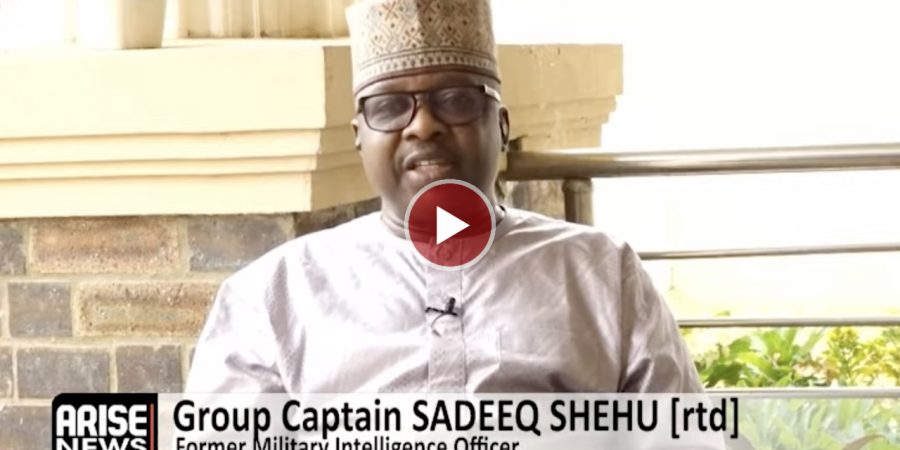
Former military intelligence officer, Group Captain Sadeeq Shehu (Rtd), has said that the bulk of Nigeria’s security challenges are driven by internal factors, stressing the need for honest reflection and locally-driven solutions.
Speaking in an interview on ARISE News on Saturday, Shehu said, “I think I can say 80 or 90 percent of the problems, whether in the Northeast, whether in the North Central, whether in Kwara State, it has to do with a local problem, and it is a homegrown problem.”
He made the remarks while reacting to the recent attack in Jos, Plateau State, which claimed several lives and marked a shift from rural to urban violence.
According to him, the incident in Jos should be deeply concerning for authorities, particularly because it occurred within a major city and near a military formation.
“The Jost incident, which happened in Anguwa-Rukuba… is the area where the 3rd Armored Division is located. So it’s really, you know, frightening that an attack can happen in that area in the metropolis of Jos,” he said.
He added that while speculation has surrounded responsibility for the attack, there is still no confirmed perpetrator.
“Based on the available information on the ground, we do not know who was responsible for that attack,” he stated.
Shehu, however, rejected attempts to frame the violence strictly as terrorism, arguing instead that the crisis in Plateau reflects deeper communal tensions.
“I still think it… is an intercommunal violence between people that have not agreed to live among themselves and to live and allow other people to also live,” he said.
He urged stakeholders within Plateau State to take responsibility for resolving the crisis, noting that over-reliance on external explanations undermines genuine solutions.
“There is this tendency that I see sometimes when a security problem overwhelms our security forces, we are always looking for external actors,” he said.
“We have to be very honest with ourselves and look for homegrown solutions, whether they’re in governance, whether it is in intelligence.”
Beyond the Jos attack, Shehu also addressed broader regional security efforts, particularly the challenges facing the Multinational Joint Task Force (MNJTF) combating Boko Haram in the Lake Chad Basin.
He described the force as necessary but structurally flawed, noting that it lacks true operational unity.
“It is not yet a joint task force, you know, per se… the troops are operating within its own borders,” he said.
He pointed out that restrictions tied to national sovereignty limit the ability of troops to pursue insurgents across borders.
“If Nigeria is pursuing a ban on Boko Haram, as soon as it crosses into Cameroon border, the pursuing forces have to stop,” he explained.
Shehu also highlighted funding challenges, noting that Nigeria often bears a disproportionate burden in sustaining the force.
“Sometimes, Nigerian government, whether it’s announced or not, we have to pay through the nose to subsidize these countries to continue their collaboration,” he said.
He further criticised frequent leadership changes within the task force, warning that short tenures weaken operational effectiveness.
“Hardly you’ll find a commander… that stays more than two years,” he said.
On the government’s response to the Jos attack, Shehu faulted both federal and state authorities for poor communication and lack of empathy.
“Whenever you emit a communication, and you find that after two days or three days, you have to come back and clarify… then your communication is very poor,” he said.
He stressed that crisis messaging must be carefully handled to avoid deepening public frustration, especially among grieving communities.
Despite acknowledging some improvements in official responses, Shehu insisted that more work is needed to align communication, logistics, and leadership actions during national tragedies.
Faridah Abdulkadiri
Follow us on: