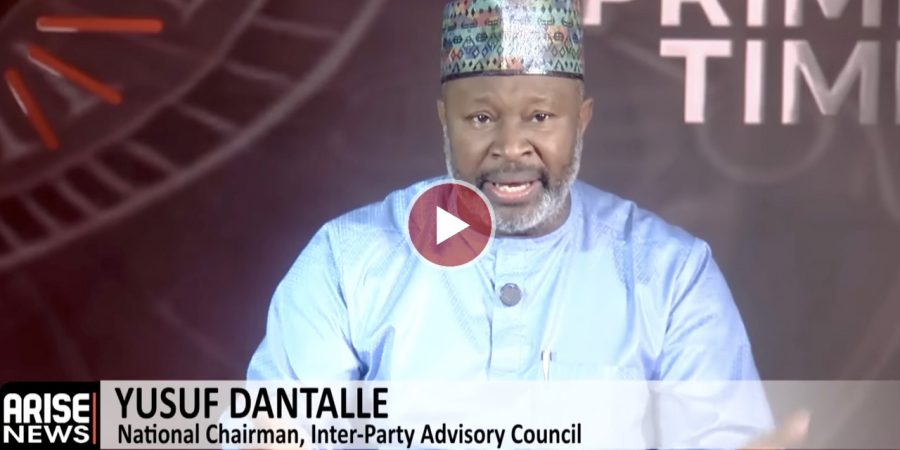
The National Chairman of the Inter-Party Advisory Council, (IPAC), Yusuf Dantalle has raised concerns over aspects of Nigeria’s Electoral Act, warning that certain provisions could disenfranchise voters and undermine democratic practice.
“Thee provisions of the law will to a greater extent disenfranchise some people or is dysfunctional in some ways”, he declared.
Criticising the short timeline for submitting membership registration, Dantalle said mandatory NIN requirements are impractical, warning they could undermine inclusivity and the credibility of elections.
“Now asking political parties to include mandatorily National Identification Numbers (NIN), is not different from going to start the process of membership registration of political parties afresh. Because whether you have it or you don’t have it, there’s no political party that does not submit its membership register to INEC before any major elections, so that is not the question.
“But now we’re going to withdraw this and review it again, okay, to include this mandatory NIN. So now the period, okay, for us to do this across the 36 states of the country, okay, is so short that we will not be able to accommodate before the election.
” It’s about four or five weeks. This is a very important activity, that have to do with what determines who becomes what in our socio-economic and political life. If you do this, what it means is that the terrain is not going to be free, it’s not going to be fair, it’s not going to be inclusive. And if it is not fair and it’s not inclusive, definitely it will affect the credibility of the election,” he explained.
Dantalle further raised concerns over weakened penalties for vote buying and certificate forgery, describing them as serious threats to democracy.
“The new electoral act have to a greater extent reduced the laws for forgery of certificate and then reduced the penalty too for vote buying. Vote buying is supposed to be a major offense, it’s anti-democratic, it’s dysfunctional. So why should we see that as something that we treat with levity?,” he quizzed.
Dantalle added that IPAC had previously recommended removing the appointment of INEC leadership from the executive to ensure true independence, but said the proposal was ignored during the Electoral Act review process.
“We had engagements with the joint committee of National Assembly on saddled with this responsibility, and we made wonderful recommendations. One of the major recommendations we made was: If this thing must be fair, free, if INEC must be independent as the name implies, the appointment of the drivers of the umpire—INEC chairman and his commissioners—should be taken away from the purview of the executive. So let it be that we have an agency, an institution that would comprise of legal luminaries, civil society organizations, political parties, and so on. But nobody discussed it. It was nothing.”
Speaking on electronic transmission of results, Dantalle called for mandatory uploads without exceptions.
“The issue of mandatory transmission, without provisos. The proviso is when there’s a network failure, that’s what they say. There are arguments that we do not have what it takes, isn’t it? To some extent. But what we are saying is with what explanation INEC has given, that with or without network, using the BVAS, if you vote and there’s no network to transmit that automatically, the moment you get to a network area, it will pick up immediately.
“So if that is it, okay, it will be an aberration to begin not to give the same legal backing, so that the IReV, what is on IReV, should have legal backing that you can easily go and pick whatever it is that is there and make it legal instead of what is manually collected,” he urged.
Dantalle said while INEC’s efforts to improve transparency in party primaries are commendable, they must be backed by strong legal frameworks.
“What we are saying is that while INEC is doing this, INEC also need the support, okay, need the enabling laws that will make them achieve that.
Addressing party defections, Dantalle said lawmakers who switch parties after winning elections should forfeit their seats to safeguard the integrity and survival of political parties.
“It was part of the recommendations we made to the National Assembly. That moving from one party after winning an election to the other—it should be automatic that you lose that seat. That you have to leave behind what you make. So some of these things also affect the health, the existence, and survival of other parties,” he said.
Speaking on INEC’s financial rules, Dantalle said parties will review nomination fees and funding standards before recommending any adjustments.
“Yesterday what INEC did was to make a presentation. But on that one in particular, we have agreed as political parties to meet and look at it again to see how favourable and/or unfavourable it is to the system. And then we will revert to INEC, if there is a need for us to go with it or adjustment be made. So for me, it will be premature to comment on that since we are going to look at it,” he explained.
The IPAC National Chairman warned that if recommended reforms are ignored, IPAC may consider boycotting the elections.
“IPAC already threatened to boycott elections, if the atmosphere is not fair, it is not inclusive. So we will also look at it again because what I’m saying is the position of the Council. So at that stage, the Council will sit again to decide what will happen. But what is important is this election must hold and then it must hold democratically,” he stated.
Favour Odima
Follow us on: