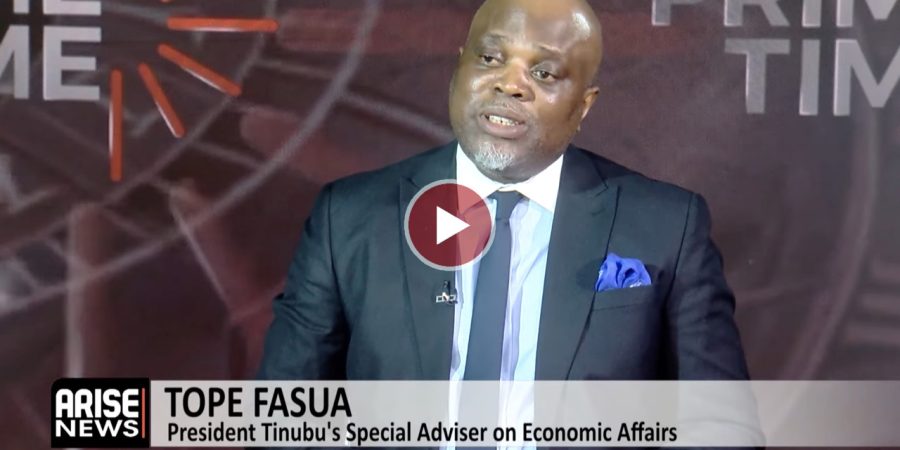
President Bola Tinubu’s Special Adviser on Economic Affairs, Dr Tope Fasua, has defended the administration’s far-reaching economic reforms, insisting that Nigeria has moved past the most painful phase of adjustment and that early gains are already visible across key indicators.
Speaking in an interview with Arise News on Tuesday, Fasua said criticism of the reforms often ignores hard data and international validation, arguing that the Tinubu administration had no option but to act decisively on fuel subsidies and foreign exchange liberalisation.
“We don’t have to struggle so hard to understand that this needed to be a government of reforms,” Fasua said.
“The reforms are paying off already, whether you look at local assessments or international validation.”
He cited Nigeria’s inclusion among countries projected to contribute meaningfully to global growth as evidence that the reforms are working.
“Nigeria wouldn’t have made it to the IMF list of countries that will contribute to global growth in 2026 if the reforms were not working. We came in sixth, contributing about 0.15 per cent to global growth, at a time when most economies are plateaued,” he said.
“That tells you this is an economy that is still growing. It remains one of the largest economies in Africa, whether we like it or not.”
Fasua rejected arguments that the reforms should have been implemented more slowly, saying hesitation would have worsened Nigeria’s economic crisis.
“In matters like this, the worst thing you can do is to prevaricate or say, ‘let’s go gradually’,” he said.
“Mr President did what needed to be done with fuel subsidies and foreign exchange. The coast is clear now. The worst is over.”
According to him, Nigeria has transitioned from a negative economic position to one of recovery.
“We are coming from a negative situation. We’ve had 10 consecutive quarters of trade surpluses. Imports are down about 20 per cent. Exports are up about 40 per cent. We’re doing 25 per cent more trade within Africa than we used to do.”
Responding to widespread public concern over the cost of living, Fasua insisted that food prices have fallen significantly, contrary to public perception.
“Food prices are down,” he said.
“Gari prices are about 70 per cent lower. Rice prices are down 30 to 40 per cent. Beans prices have dropped.”
He accused critics of what he described as “cognitive dissonance”.
“We seem stuck in this mindset that things can never get better, so we keep repeating by rote that food prices are up,” he said.
“Let the whole world hear it: food prices are down in Nigeria.”
Fasua linked falling food prices to easing inflation.
“Food inflation is down to about 11 per cent, and overall inflation is trending down around 15.15 per cent,” he said.
“We’re heading to single-digit inflation.”
He argued that claims of worsening food poverty contradict farmers’ complaints about low produce prices.
“You cannot at the same time complain about food poverty and ignore the fact that farmers are saying food prices are too low for them to go back to the farm,” he said.
“We cannot approbate and reprobate at the same time.”
Fasua said rising wages and tax reforms are already improving disposable income for many Nigerians.
“Minimum wage rose by 130 per cent, while the naira devalued by about 50 per cent,” he said.
“Everybody that works is earning more in nominal terms. Even artisans are charging more for their services.”
He added that recent tax laws signed by the president favour low- and middle-income earners.
“Anyone earning ₦25 million per annum and below is taking home more money,” he said.
“About 90 to 95 per cent of Nigerians working in compliant organisations actually got more money in their January salaries. BusinessDay reported it. Who is talking about that?”
On projections that millions more Nigerians could fall into poverty, Fasua said the issue reflects global inequality trends rather than domestic policy failure.
“We’re dealing with what I call a K-shaped economy,” he said.
“People at the top are getting richer, while the poor struggle. That’s a global phenomenon, not just Nigeria.”
He pointed to visible consumption patterns in major cities as evidence of widening inequality.
“Go to Lagos. Go to nightclubs in Abuja. The way people spend here, they don’t even do that in the US ” he said.
“So perhaps what we should really be talking about is inequality and policies that break the income gap.”
Fasua said the administration’s tax reforms are designed to address this imbalance.
“The tax law is one of the ways we intend to break the income gap,” he said.
Defending the pace of reform, Fasua said delaying action would have harmed future generations.
“There’s a Swahili saying: the best time to plant a tree was 20 years ago. The next best time is today,” he said.
“If we want our children’s lives to be better, we cannot wait till tomorrow.”
He cited improvements in Nigeria’s external reserves as further proof of progress.
“We’ve moved our foreign reserves from about $3.5 billion net to $46–47 billion,” he said.
“The naira is stable. We have international recognition for how this economy is being managed.”
Fasua concluded by urging Nigerians to move away from pessimism.
“We have to move away from this idea that things will never get better in Nigeria,” he said.
“We’ve seen the worst. We’ve gone through the worst scenarios. Now is the time for growth and for people’s lives to improve.”
Boluwatife Enome
Follow us on: