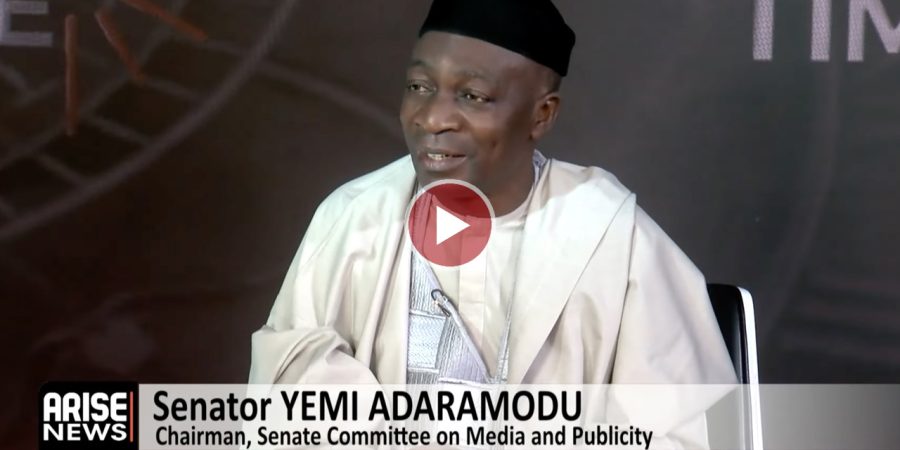
Chairman of the Senate Committee on Media and Publicity, Senator Yemi Adaramodu, has defended the implementation of overlapping budgets in recent years, insisting the approach was a deliberate fiscal strategy to prevent abandoned projects and stabilise Nigeria’s economic recovery.
Speaking in an interview with ARISE News, Adaramodu said that the National Assembly has now moved to end the practice through a repeal-and-reenact process that will consolidate outstanding capital components and ensure a clean fiscal transition.
He added that the current situation was a carryover from the transition into the 10th National Assembly and the early reforms of President Bola Ahmed Tinubu’s administration.
“Yes, it’s already at a stopping level now. Thank you very much for that very pertinent question and observation. Yes, 2023, when the current government, the executive government of President Bola Ahmed Tinubu, and even our own 10th Senate and the 10th National Assembly came into being, the budget had already been done earlier before,” he said.
He explained that economic reforms introduced at the start of the administration — including fuel subsidy removal and the floating of the naira — necessitated supplementary appropriations.
“There were steps taken by the government of President Tinubu like the first subsidy removal, the issue of naira redesign, and the dollar and other foreign currencies to flex their muscles naturally and appropriately so that we can get where we are going now by the value of the naira, which we call floating of the naira. So definitely there were hills and cries then,” Adaramodu said.
“So there was another supplementary budget in order to take that into consideration. Then we were calling it palliatives for Nigerians — that okay, if we have taken biscuit from a child, definitely we have to give that child an akara.”
According to him, the Senate deliberately allowed the 2023 supplementary budget and the 2024 budget to run concurrently to avoid stalled capital projects.
“We said, look, let us just make sure that we get out of this kind of fiscal conundrum and then get a budget that can get us out of it. Then that was when we now said the supplementary of 2023 and the remaining of 2023 and that of 2024 should run together so that we will not have abandoned projects.”
He stressed that allowing budgets to lapse strictly at year-end would have worsened infrastructure decay.
“If the year runs out fiscally and whatever would have been appropriated for in the previous year would end like that, then it means that there will be abandoned projects. And we didn’t want that one to happen,” he said.
Adaramodu disclosed that the Senate and the executive had now agreed to repeal all overlapping budget regimes and enact a consolidated framework.
“We are repealing any other budget regime — either it is 2024 or 2025 — and we are now enacting a budget that is going to encapsulate all those leftovers together with the current one,” he said.
“The capital components which had not been fulfilled should be put together so that between now and March 31, 2026, we will exit that. Then the fresh budget of 2026 will take effect, and we will not go back to that kind of relapsing fiscal fever anymore.”
On criticisms that the executive presents “unrealisable” budgets, Adaramodu rejected the notion, describing budgeting as a predictive and experience-driven exercise.
“When we say budget, it is like proposal. Propositions. Thinking. At times speculative,” he said.
“There is no item on any budget that we call unrealisable. Government proposes based on experience — this is the revenue we have been getting, and based on that, we propose what we want to do.”
He added that unforeseen global events often affect projections.
“Nobody knew that there would be COVID. It came globally and impacted negatively on the global economy. Beyond that, the Ukraine–Russia war started. And Nigeria is not an island. Oil is the mainstay of our economy, so definitely it will impact either negatively or positively,” he said.
“So it is not deliberate. It is about circumstances.”
Adaramodu also dismissed concerns that defections into the ruling All Progressives Congress (APC) threaten Nigeria’s multi-party democracy.
“Anywhere in the world — even in heaven or hell — you choose where you want to go. You cannot tell somebody who believes this is the progressive party that they cannot come,” he said.
Defending the economic direction of the Tinubu administration, he argued that borrowing, when done prudently, was not unusual.
“Is there any country in the world that does not go to the borrowing market? It depends on what you are taking the facilities for — to develop and to impact the indices within your economy,” he said.
He cited recent improvements in prices and exchange rate stability.
“Last year December, I bought a bag of rice at ₦103,000. Today, I am buying the same at ₦51,000 or ₦52,000. Are you telling me there have never been changes?” he asked.
“For the first time in the history of Nigeria, people can go to the exchange market, buy dollars at a certain amount, and within weeks it remains the same.”
On electoral reforms, Adaramodu said amendments to the Electoral Act were ongoing and would be completed ahead of the 2027 general elections.
“Democracy is not a destination; it is a process. Experience will always lead to the kind of law you are going to make,” he said.
“The new Electoral Act will come out very early next year because INEC must publish the timetable for 2027.”
Addressing internal Senate controversies, Adaramodu dismissed claims of rifts within the leadership.
“There has never been any rift between the President of the Senate and anyone. There was only an issue of interpretation and observance of Senate rules,” he said.
“We have laws. It is not a motor park. Anybody that does not adhere to the rules cannot just take it.”
On ambassadorial screenings, he defended the Senate’s procedures.
“We do not act on impulse. We do not act on social media. If anyone has anything against any nominee, bring a petition,” he said.
“Screening was done in the open. The public was there. So we must not be sentimental or romantic with our thinking.”
Adaramodu insisted the Senate remained focused on governance and stability.
“Everything is calm. Everything is going on very well,” he said.
Boluwatife Enome
Follow us on: