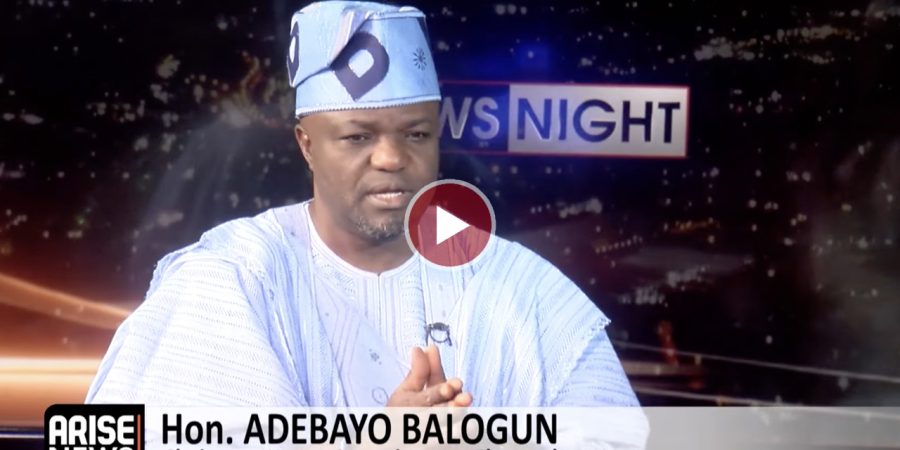
Chairman of the House Committee on Electoral Matters, Hon. Adebayo Balogun, has said that ensuring a fully digital and foolproof voter accreditation process would resolve about 90 per cent of Nigeria’s electoral challenges, insisting that accreditation, not result transmission, remains the most critical element of credible elections.
Balogun Speaking in an interview on ARISE News on Thursday said recent amendments to the Electoral Act were aimed at strengthening public confidence in the process while clarifying existing provisions on technology deployment.
The lawmaker explained that the controversy surrounding electronic transmission of results was largely a matter of perception rather than substance.
“When it comes to the issue of transmission, what we’ve just done is to change the word ‘transfer’ to ‘transmit’, which actually means the same thing,” Balogun said.
“But perception is very important. Nigerians want to hear transmission, so we put it there the way people are comfortable with it.”
He clarified that the law already requires presiding officers to upload polling unit results, but network challenges across the country make real-time transmission unrealistic in some areas.
“Every part of Nigeria is not Abuja or Lagos. Even in Abuja and Lagos, you still have network failures,” he said.
“Once the result is ready, you must snap it and send it in the presence of all agents. Whether it goes real-time or delayed depends on network availability.”
Balogun stressed that presiding officers would not be held responsible for network failures beyond their control.
“Once you snap and send, you have done your part. The remaining part is with the network providers,” he said.
“We must be careful because these presiding officers are about 90 per cent youth corps members, and the punishment is now higher — up to five years.”
Responding to claims that the House was overriding the Supreme Court’s position on INEC’s discretion in result transmission, Balogun said the amendment did not alter the substance of the law.
“What people are saying is that ‘transfer’ does not mean ‘transmit’. We didn’t really change anything — just the metrics,” he said.
“The Supreme Court made it clear that the Result Viewing Portal is not a collation centre. It’s like sending a photocopy. It does not automatically add figures together.”
He insisted that while transmission is important, digital accreditation through the Bimodal Voter Accreditation System (BVAS)remains the most decisive reform.
“The most important element that has changed Nigeria’s electoral process is the BVAS — the accreditation system,” Balogun said.
“Once you ensure that accreditation is digital and foolproof, you have solved 90 per cent of the electoral process.”
According to him, BVAS has effectively addressed over-voting, which was common in previous elections.
“Before BVAS, people waited for rural areas to bring in figures larger than metropolitan areas. Those were cooked-up figures,” he said.
“Now, because of BVAS, those areas can no longer chunk in large figures again.”
Balogun rejected claims of voter suppression during the 2023 elections, attributing complaints to changed expectations.
“People said there was voter apartheid. No. If you look at physical turnout, people actually turned out more,” he said.
“But because we were used to inflated figures before, the real numbers now look strange.”
On post-election litigation, Balogun said the ongoing constitutional review aims to drastically reduce disputes after elections by resolving issues earlier.
“Most post-election cases are actually pre-election matters — qualification issues, primaries and party disputes,” he said.
“Our objective is to conclude pre-election matters before the general election, so there will be little or nothing to litigate afterwards.”
He cited recent cases where elected officials were removed after being sworn in as evidence of systemic flaws.
“We don’t want a situation where people who have been sworn into office are later removed because of issues that should have been settled before the election,” he said.
Addressing concerns about selective enforcement of electoral laws, Balogun said misinformation and unrealistic expectations contributed to public distrust.
“INEC did not promise what many people think it promised,” he said.
“People expected real-time figures like CNN, with numbers changing live. That was never what the law said.”
He explained that delays in uploading results during the 2023 elections were often misinterpreted.
“Elections were held simultaneously. Results were snapped together,” Balogun said.
“Some uploaded immediately, some took hours. But many people complaining never even checked their own polling unit results.”
On strengthening INEC, Balogun said the House was considering broader institutional reforms, including the creation of an Electoral Offences Commission.
“We are working on the Electoral Offences Commission Bill to try electoral offenders,” he said.
“We are also reviewing voter education responsibilities and looking at proposals to unbundle INEC’s functions.”
He added that legislative decisions ultimately reflect collective agreement, not individual preferences.
“Even bills that were very dear to me were dropped,” Balogun said.
“It’s about the majority. After committee work, what matters is what the House decides.”
Balogun said sustained public engagement and education remain essential to restoring confidence in Nigeria’s electoral system.
“We must keep talking to Nigerians and let them understand the process,” he said.
Boluwatife Enome
Follow us on: